Many contractors in Bunbury skip the CBR study and rely on old pavement data. That leads to premature cracking or unexpected settlement within two years. A proper CBR study for road design determines the California Bearing Ratio of the subgrade at field moisture conditions. Without those numbers, pavement thickness design is guesswork. For local roads connecting the Port of Bunbury or residential estates in Glen Iris, the difference between a 150 mm and 250 mm base layer affects both budget and lifespan. The test is straightforward: a plunger is driven into compacted soil samples, and the resistance is compared to a standard crushed rock. Results guide the structural number in AASHTO-based pavement design. We always pair the CBR test with granulometria to understand the particle-size distribution that controls drainage and compaction behavior under traffic loads.
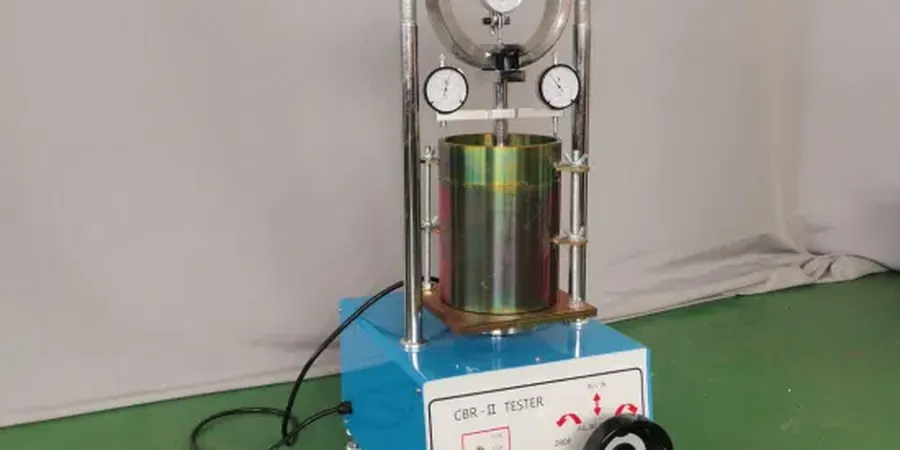
A soaked CBR below 3 in Bunbury's estuarine clays means the subgrade cannot support standard pavement without chemical stabilisation.
Approach and scope
Site-specific factors
Bunbury sits on the Swan Coastal Plain, where sands, silts, and soft clays alternate within a few metres of depth. The water table is shallow near the coast and around the Leschenault Inlet. If a CBR study for road design is based on dry-season samples only, the soaked CBR can drop by 60 % when the water table rises. That causes base-course pumping and surface rutting within one wet winter. Roads in Bunbury's industrial zones near the port carry heavy truck traffic. A design based on an unsoaked CBR of 12 may fail when the actual soaked value is 4. The result is premature pavement failure, costly overlays, and traffic disruption. We always test at field moisture and soaked conditions to capture the full seasonal range.
Regulatory framework
AS 1289.6.1.1 – Determination of the California Bearing Ratio, AS 1289.5.1.1 – Compaction control test (standard and modified), AUSTROADS Pavement Design Guide (2021)
Related technical services
Soaked CBR Testing
Samples are compacted at OMC and soaked for 96 hours. The plunger penetration test measures bearing capacity under saturated conditions. This is the worst-case scenario for Bunbury's winter water table.
Unsoaked CBR Testing
Test performed immediately after compaction at OMC without soaking. Useful for dry-season construction and upper pavement layers where drainage is controlled.
Field In-Situ CBR
Direct penetration test on the subgrade at its natural moisture and density. Avoids the disturbance of sampling. Recommended for existing road rehabilitation projects.
CBR Correlation with Other Tests
We cross-reference CBR results with DCP (Dynamic Cone Penetrometer) readings and laboratory classification to extend the data set across long road corridors without drilling every 50 m.
Typical parameters
Top questions
How long does a CBR study for road design take in Bunbury?
A standard soaked CBR test requires 96 hours of soaking plus compaction and penetration time. Total turnaround is 5 to 7 working days from sample receipt. Unsoaked tests are completed in 2 to 3 days.
What is the cost of a CBR study for road design in Bunbury?
The typical cost ranges between AU$250 and AU$540 per test point, depending on whether it is soaked or unsoaked and the number of samples per project. Bulk discounts apply for corridor-length pavements.
Can CBR results be used for both flexible and rigid pavement design?
Yes. CBR values are used directly in the AASHTO flexible pavement design method to determine the required base and subbase thickness. For rigid pavements, the CBR correlates with the modulus of subgrade reaction (k-value) used in concrete slab design.