Bunbury's expansion as the southwest gateway has driven extensive road and industrial development since the 1840s. The city's coastal geology, featuring sandy soils over weathered granite and occasional clay lenses, demands reliable subgrade assessment. Laboratory CBR testing provides the calibrated data needed for pavement design in this environment. Before placing any structural fill, geotechnical teams often combine CBR results with a granulometry analysis to classify the soil and with compaction testing via Proctor to establish optimum moisture targets. These three parameters together define the bearing capacity envelope for any road section in Bunbury.
A soaked CBR below 2 in Bunbury's winter-wet subgrade is a structural risk that demands stabilisation before any pavement layer is placed.
Approach and scope
Site-specific factors
AS 1289.6.1.1 sets the benchmark for laboratory CBR in Australia, but interpreting results for Bunbury requires local judgment. The city's seasonal water table can rise within 1.5 m of the surface after heavy winter rain, turning a dry CBR of 12 into a soaked CBR of 3. Designing pavements based on dry values alone leads to premature rutting and cracking. The risk is especially acute in low-lying suburbs such as Withers and parts of Glen Iris, where drainage is poor. For these zones the laboratory CBR should always be run under soaked conditions to represent the worst-case scenario.
Regulatory framework
AS 1289.6.1.1: Soil strength and consolidation tests — CBR test, AS 1289.5.1.1: Compaction control — Standard compactive effort, Austroads Guide to Pavement Technology Part 2: Pavement Structural Design
Related technical services
Soaked CBR (4-day immersion)
Standard laboratory procedure with 96-hour soaking, ideal for Bunbury's winter-wet subgrades. Includes swelling measurement and the full force-penetration curve.
Unsoaked CBR (rapid screening)
Same compaction and penetration method but without soaking. Suitable for preliminary assessment of granular fills or for projects where moisture control is guaranteed. Results ready within 24 hours.
Typical parameters
Top questions
How much does a laboratory CBR test cost in Bunbury?
The typical price range for a laboratory CBR test in Bunbury is between AU$170 and AU$340 per test. Costs vary depending on whether the sample requires soaking, the number of compaction points, and whether the client needs a full report with swelling data.
What is the difference between soaked and unsoaked CBR?
The soaked CBR simulates worst-case moisture conditions by immersing the compacted specimen for 96 hours, measuring both swelling and penetration resistance. The unsoaked test omits the immersion step and gives a higher CBR value. For Bunbury's winter-wet subgrades, the soaked value is the relevant design parameter.
Which Australian standard governs the laboratory CBR test?
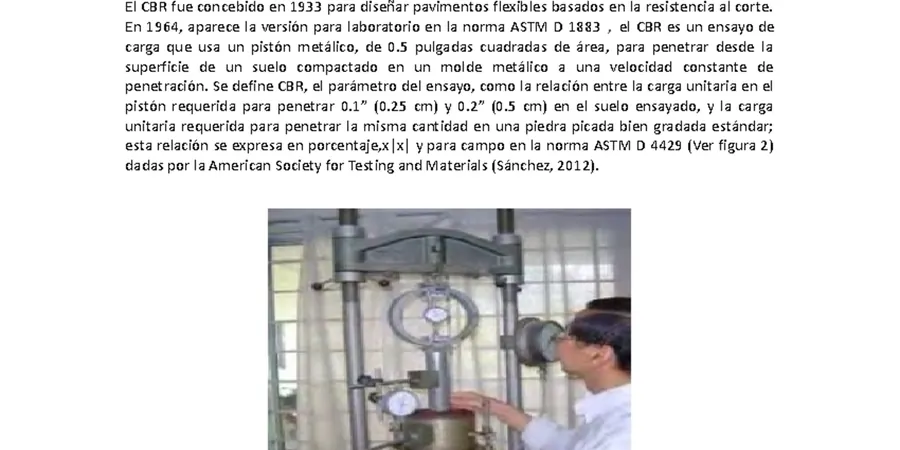
The test is governed by AS 1289.6.1.1, which specifies the mould dimensions, compaction effort (56 blows per layer for standard), soaking procedure, penetration rate of 1.0 mm/min, and the method for calculating the CBR ratio at 2.5 mm and 5.0 mm penetration.
Can I use the same CBR sample for Proctor compaction?
Yes, the same compacted CBR specimen can be used to determine the dry density and moisture content after the penetration test. The Proctor curve is typically established first to set the target moisture, then the CBR is run at that optimum moisture content.