Bunbury grew rapidly after the 1890s port expansion, with much of the inner-city built on the Bassendean Sand and Guildford Formation. These Quaternary deposits control how stormwater and effluent move through the ground. An infiltration test in Bunbury measures the vertical permeability of the unsaturated zone, data that directly informs soakwell sizing, leach drain design, and WSUD compliance. Before any percolation-based system is approved, local councils require field-measured hydraulic conductivity. Our team runs both the Porchet method for shallow pits and the double-ring infiltrometer for undisturbed surface layers, covering the full range of residential and commercial lot conditions.
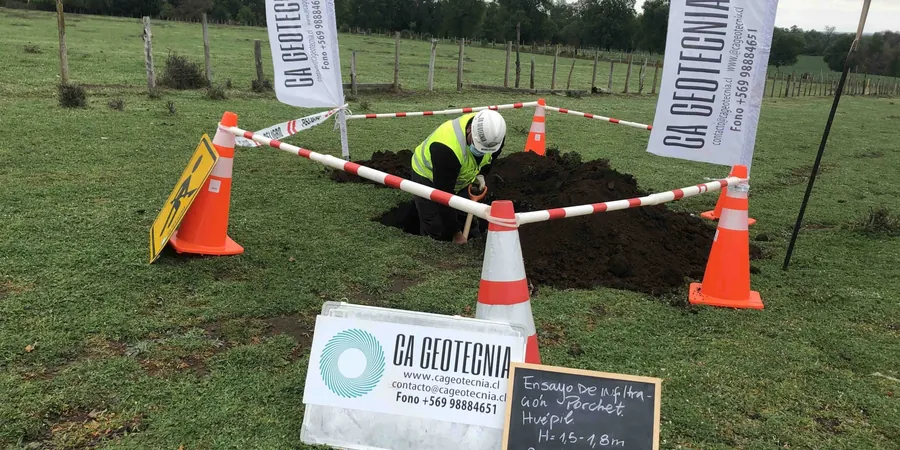
A single percolation rate from one borehole can misrepresent Bunbury's heterogeneous Bassendean Sand; multiple test pits are essential.
Approach and scope
Site-specific factors
The double-ring infiltrometer kit we deploy in Bunbury consists of two concentric stainless-steel rings, a Mariotte bottle for constant head, and a graduated cylinder. Water is trucked in when the site lacks a supply, which is common in the outer estates. The risk of overestimating Ksat is real if the soil is only wetted for a short period; we pre-wet for at least 24 hours to reach steady-state flow. On sites with shallow water table, the test becomes invalid because the wetting front merges with the phreatic surface. Our field crew logs the depth to groundwater before starting and flags those locations immediately.
Regulatory framework
AS 4678-2002 Appendix C, DWER (WA) Site Suitability Guidelines, AS 1289.6.8.1 (double-ring infiltrometer)
Related technical services
Porchet Infiltration Test
Excavation of a 0.3–1.5 m deep pit, pre-wetting to field capacity, and measurement of falling head over time. Best suited for residential soakwells and small-scale drainage. Reported as Ksat in m/day with a design recommendation.
Double-Ring Infiltrometer Test
Surface or near-surface constant-head test using concentric rings to eliminate lateral flow. Required for large retention basins, commercial infiltration systems, and WSUD applications. Results include steady-state infiltration rate and cumulative infiltration curve.
This service complements our laboratory testing work for a complete project analysis.
Typical parameters
Top questions
How many infiltration test pits are typically required for a residential lot in Bunbury?
Most local councils in the South West region require a minimum of three test pits per lot, distributed across the proposed drainage footprint. On larger blocks or where the Bassendean Sand shows visible variability, we run five or more pits to capture the spatial heterogeneity.
What is the difference between Porchet and double-ring infiltrometer tests?
The Porchet test uses a single excavated pit and measures falling head; it is simpler and cheaper but can be affected by lateral seepage through pit walls. The double-ring infiltrometer drives two concentric rings into the ground and maintains a constant water level in the inner ring, isolating vertical flow. For Bunbury's sandy soils, the double-ring method gives a more conservative and repeatable Ksat value.
How long does the infiltration test take on a typical Bunbury site?
Field work for a standard residential lot takes about 4–6 hours, including pit excavation, pre-wetting, and data collection. Laboratory analysis and reporting add two working days. Sites with cemented pans or shallow water table may require additional pre-wetting time.
What is the typical cost range for an infiltration test in Bunbury?
For a standard residential block with three Porchet pits, expect between AU$520 and AU$660 including a written report with design Ksat values. Double-ring tests for commercial sites are quoted per test point and typically start around AU$450 per ring set-up.