Many construction firms in Bunbury assume the sandy soils common to the Swan Coastal Plain provide adequate subgrade support without dedicated design. That assumption leads to differential settlement and premature pavement cracking within months. The subsurface profile here varies significantly from the coastal dunes near Koombana Bay to the clay-rich flats along the Preston River. Without a thorough road subgrade design tailored to these local conditions, even well-constructed roads develop rutting and loss of ride quality. A proper investigation should combine dynamic cone penetrometer testing with laboratory CBR analysis to establish the design California Bearing Ratio for each pavement layer. Complementing that with a plate load test on the finished subgrade verifies the modulus of reaction assumed in the structural design.
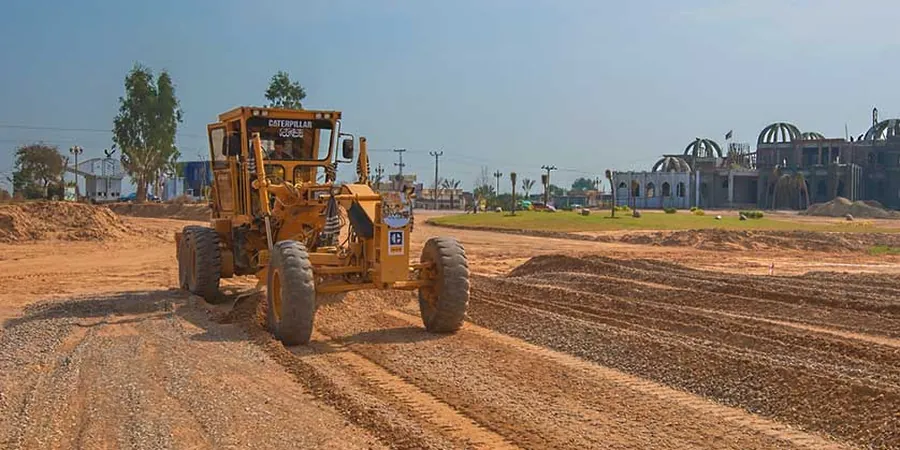
The soaked CBR value, not the dry one, drives the structural pavement design in Bunbury's wet-winter climate.
Approach and scope
- Dynamic cone penetrometer profiling every 50 m along the alignment
- Undisturbed sampling of cohesive layers for triaxial testing
- Modified Proctor compaction curves for each material zone
Site-specific factors
Bunbury expanded rapidly from the 1960s as a port and industrial hub, with many residential subdivisions built on former wetlands and low-lying paddocks east of the city centre. Those areas typically contain compressible silty clays and peat lenses that, if not identified during site investigation, cause uneven settlement after pavement construction. A road subgrade design that ignores these buried soft zones risks longitudinal cracking along utility trenches and at bridge approaches. The geotechnical team must correlate borehole logs with historical land-use maps to identify filled ground and organic deposits before assigning design parameters. Using the CBR test for pavements on undisturbed samples from these suspect layers provides the real bearing capacity rather than relying on assumed values from regional soil maps.
Regulatory framework
AS 1726 – Geotechnical site investigations (2017), Austroads Guide to Pavement Technology Part 2: Pavement Structural Design (2021), AS 1289.6.1.1 – Standard Test Method for CBR (California Bearing Ratio) of Laboratory-Compacted Soils
Related technical services
Subgrade Investigation & CBR Testing
Comprehensive field and laboratory testing including dynamic cone penetrometer surveys, modified Proctor compaction, and soaked CBR determination. All tests follow AS 1726 and ASTM standards, performed by NATA-accredited technicians.
Pavement Structural Design & Moisture Analysis
Austroads-compliant structural number calculations using site-specific CBR and modulus values. Includes seasonal moisture monitoring, drainage recommendations, and subgrade improvement options such as lime stabilisation or geotextile separation.
Typical parameters
Top questions
What is the typical cost range for a road subgrade design study in Bunbury?
For a standard residential subdivision or local road project in Bunbury, the cost ranges between AU$1,510 and AU$4,900 depending on site size, number of boreholes, and laboratory testing scope. A detailed quote can be prepared after reviewing the project's pavement class and alignment length.
How many test pits or boreholes are needed for a reliable subgrade design?
Austroads recommends a minimum of one investigation point per 100 m of road alignment, with additional points at culvert crossings and changes in topography. For Bunbury's variable geology, our team typically spaces boreholes 50–80 m apart along the centreline and at shoulder locations to capture lateral variability in CBR values.
Why does the soaked CBR matter more than the dry CBR for Bunbury roads?
Bunbury receives over 800 mm of rain annually, mostly in winter, so the subgrade reaches near-saturation during service. The soaked CBR (tested after 96 hours of soaking) simulates that condition and yields a lower bearing capacity. Designing to the dry CBR overestimates pavement strength and leads to premature failure within 2–3 wet seasons.
How long does a road subgrade investigation take in Bunbury?
Fieldwork typically takes 2–4 days for a 1 km road section, depending on access and ground conditions. Laboratory testing (compaction, CBR, Atterberg limits) adds 7–10 working days. The full design report including pavement thickness recommendations is delivered within 3 weeks from site start.