Bunbury sits on the Swan Coastal Plain, with sandy soils over limestone and clay layers that shift dramatically between the coast and the escarpment. The high winter rainfall — over 800 mm annually — saturates these profiles, making natural slopes and engineered cuts prone to seepage-driven failure. Our team has designed stabilization systems for residential subdivisions, road cuts, and coastal bluffs across the city. We combine limit equilibrium analysis with unsaturated soil mechanics, and where pore pressures are critical, we integrate drenaje geotécnico to control water before it triggers movement. Every design starts with a site-specific geotechnical model, not a textbook assumption.
We design for Bunbury’s winter saturation, not the dry summer profile — that’s where most failures start.
Approach and scope
Site-specific factors
A residential development on the eastern slopes of Bunbury required a 12 m cut into weathered sandstone. During the first winter, a perched water table emerged at the interface with a clay seam, reducing effective stress by 40%. The original design had assumed dry conditions. We redesigned the slope with a drainage blanket and horizontal wick drains, then re-analyzed using coupled effective stress analysis. The factor of safety went from 0.95 to 1.55. That project taught us — Bunbury’s seasonal water table is the single biggest risk in slope stabilization design here.
Regulatory framework
AS 4678:2002 Earth-retaining structures, AS 1726:2017 Geotechnical site investigations, AS/NZS 1170.4:2007 Structural design actions – Earthquake actions
Related technical services
Slope Stability Analysis & Design
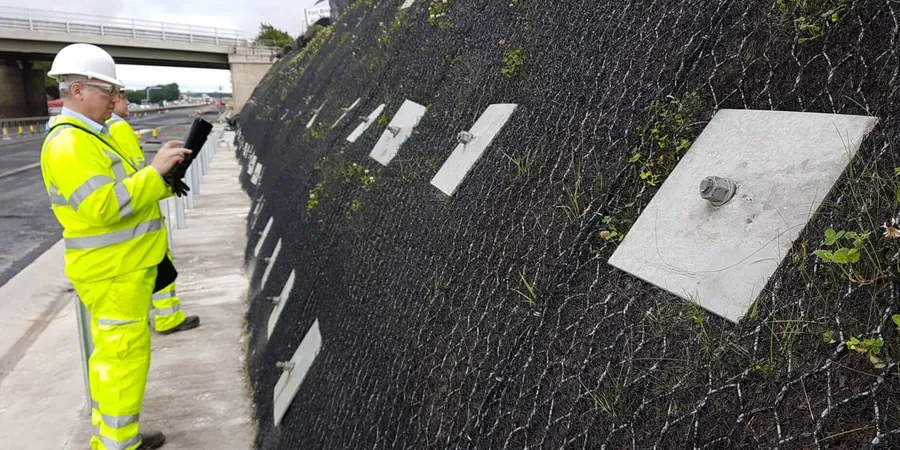
Limit equilibrium and finite element analysis for natural slopes, road cuts, and embankments. Includes seepage modeling, sensitivity analysis, and reinforcement specification (soil nails, anchors, geogrids). Reports include factor of safety calculations and construction recommendations.
Retaining Wall Design for Slope Support
Design of gravity walls, cantilever walls, soil nail walls, and anchored walls per AS 4678. We incorporate surcharge loads, seismic acceleration, and drainage details. All designs are signed by a registered professional engineer.
Typical parameters
Top questions
What is the typical factor of safety required for slope stabilization in Bunbury?
For permanent slopes under static conditions, we target a minimum factor of safety of 1.5 per AS 4678. Under seismic loading (AS/NZS 1170.4), we accept 1.1. Temporary cuts during construction may be designed to 1.3, provided monitoring is in place.
How does seasonal rainfall affect slope stability in Bunbury?
Bunbury receives over 800 mm of rain per year, concentrated between May and October. This saturates sandy soils above clay aquitards, creating perched water tables that reduce effective stress. We model transient seepage and design drainage systems to keep pore pressures below critical levels.
What is the cost range for a slope stabilization design in Bunbury?
A typical slope stabilization design for a residential development in Bunbury ranges between AU$2.810 and AU$8.650, depending on slope height, complexity, and the number of reinforcement systems required. We provide a fixed-price quote after the initial site inspection.
Do you use limit equilibrium or finite element methods for design?
We use both. Limit equilibrium (Bishop, Spencer) is standard for most slopes. For complex geometry, seepage interaction, or soil-structure interaction, we apply finite element analysis (e.g., PLAXIS, Slide3). The choice depends on the risk profile and site conditions.