Soils in Bunbury near the Leschenault Estuary are often sandy and permeable, while areas around Carey Park have more clay and silt layers. That contrast makes understanding groundwater flow critical here. A laboratory permeability test (falling/constant head) gives you the hydraulic conductivity value you need before any excavation or foundation design. We run both methods in our Bunbury lab, matching each soil type to the right procedure. Sandy samples go through constant head; fine-grained ones use falling head. Before testing, we also recommend a granulometric analysis to classify the material and a site infiltration test to compare lab results with field conditions. This combined approach helps avoid surprises when water shows up during excavation.
A single permeability value can change your drainage design completely – sandy soils in Bunbury can be ten times more conductive than clay layers just a metre below.
Approach and scope
Site-specific factors
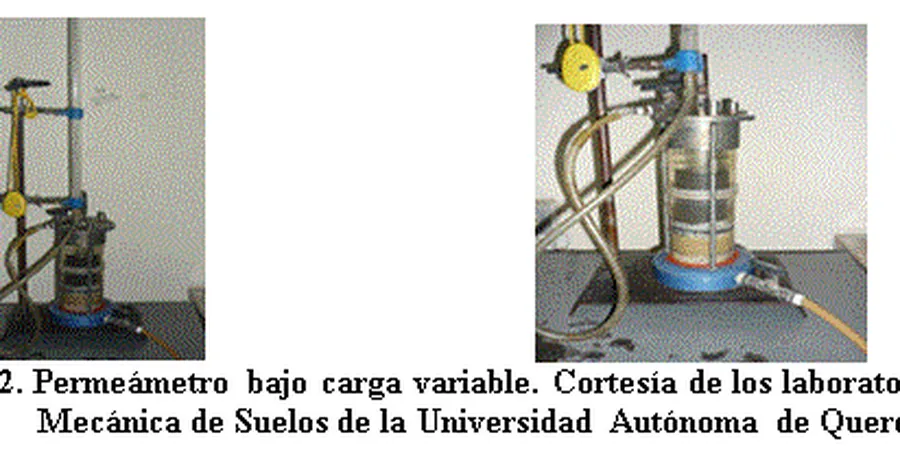
The permeameter cells we use in the Bunbury lab are made of clear acrylic with graduated manometers. For constant head tests we keep a steady water level using a Mariotte bottle. Falling head requires a standpipe and precise timing with a stopwatch. One common risk is sample disturbance during trimming – if the soil structure changes, the k-value is meaningless. We also check for air bubbles in the system. Trapped air blocks flow and gives false low readings. Our technicians de-air all water before a test. In Bunbury where groundwater can be saline near the coast, we use local water matching site chemistry to avoid osmotic effects that alter results.
Regulatory framework
AS 1726-2017 Geotechnical site investigations, AS 1289.6.7.1 Determination of permeability of a soil – Constant head method, AS 1289.6.7.2 Determination of permeability of a soil – Falling head method
Related technical services
Constant head permeability test
For clean sands and gravels. Water flows through the sample under a constant head. We measure volume over time and calculate k. Suitable for drainage layer design, filter specification, and dewatering assessment.
Falling head permeability test
For silts and clays. Water level drops in a standpipe as it flows through the sample. We record head difference over time. Used for clay liners, landfill caps, and seepage analysis in fine-grained soils.
Typical parameters
Top questions
What is the difference between falling head and constant head permeability tests?
Constant head maintains a steady water level above the sample – used for sandy soils where flow is fast. Falling head lets the water level drop over time – used for clays and silts where flow is slow. Both follow AS 1289.6.7.1 and AS 1289.6.7.2 respectively.
How much does a laboratory permeability test cost in Bunbury?
A typical falling or constant head test in our Bunbury lab costs between AU$570 and AU$1070 per sample. The range depends on sample preparation, number of specimens, and whether you need remoulded or undisturbed testing. Contact us for a quote tailored to your project.
Do I need a permeability test for a small residential slab in Bunbury?
Yes, if your site has variable soils like the sandy areas near Ocean Drive or clay pockets in the inner suburbs. A lab test gives you a reliable k-value for drainage design. Without it you risk under-sizing soakwells or getting water ingress under the slab.
Can I use field permeability results instead of lab tests?
Field tests measure in-situ conditions including natural layering and fissures. Lab tests give you a controlled value for a specific soil layer. For most Bunbury projects we recommend both – field for overall site assessment and lab for design parameters per AS 1726.