A common oversight we see in Bunbury is treating a sloped site as if it were flat. Builders often order a standard soil test and assume it covers slope performance. It doesn’t. Bunbury’s terrain, shaped by the Leeuwin-Naturaliste ridge and the coastal plain, creates a mix of sandy colluvium over weathered granite. Without a dedicated slope stability analysis, you risk underestimating the driving forces acting on a cut face. We’ve walked onto projects where the excavation looked fine until the first heavy winter rain, then the face started slumping. That’s why we run Bishop simplified and Morgenstern-Price methods here, calibrated to local soil data. Before you break ground, pair this study with a granulometry test to understand the grading of those sandy layers and their drainage behavior.
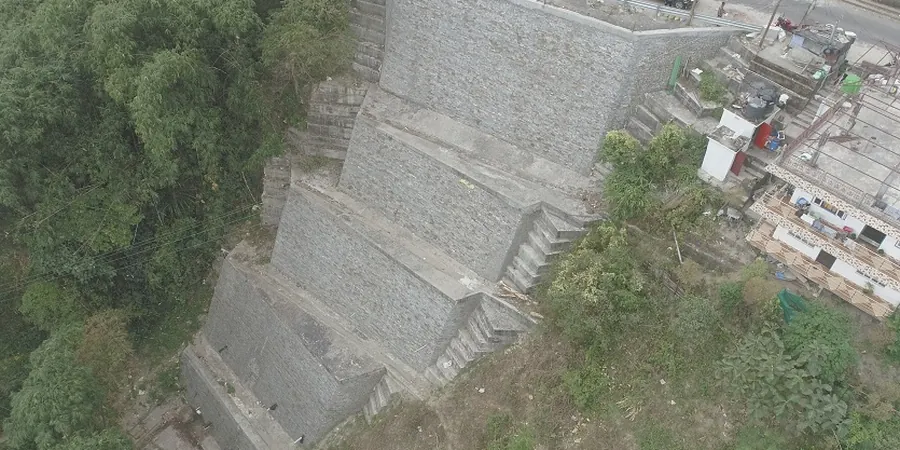
Bunbury’s coastal sands and weathered granite slopes can lose strength rapidly when saturated – the critical failure mode is often after three days of continuous rain.
Approach and scope
- Effective cohesion (c') and friction angle (φ') from consolidated drained triaxial tests
- Unit weight and moisture content from undisturbed sampling
- Pore pressure ratio (ru) from seasonal monitoring
- Factor of safety under static and pseudo-static conditions per AS/NZS 1170.2
Site-specific factors
In Bunbury, we frequently see slopes that appear stable in dry conditions but fail after prolonged rainfall. The sandy colluvium over granite drains quickly, but the interface layer can trap water, building up pore pressure. One subdivision near the Preston River lost a section of road shoulder because the design assumed drained conditions year-round. We also note that old farm cuts from the 1970s were made without benching or drainage. A proper slope stability analysis identifies these hidden slip surfaces before they become a liability. Ignoring it can lead to costly retaining walls or even property damage downhill.
Regulatory framework
AS 4678:2002 – Earth-retaining structures (slope component), AS 1726:2017 – Geotechnical site investigations, AS/NZS 1170.2:2021 – Wind actions (pseudo-static seismic check)
Related technical services
Cut Slope Assessment for Residential and Commercial Sites
For sites on the ridges around Bunbury, we assess existing and proposed cut faces. We inspect tension cracks, seepage zones and vegetation changes, then run limit equilibrium back-analysis to confirm the required batter angle.
Embankment Stability on Soft Coastal Soils
New fill embankments near the Leschenault Estuary need careful staged construction. We model short-term undrained conditions and long-term drained strength, checking for bearing failure beneath the fill.
Landslide Investigation and Remediation Design
When a slope has already moved, we investigate the failure mechanism with boreholes, inclinometers and shear testing. We then design drainage, soil nailing or buttressing to restore stability.
Typical parameters
Top questions
When is a slope stability analysis required in Bunbury?
Typically when the cut or fill slope exceeds 3 metres, or when the site is within 30 metres of a natural slope steeper than 1 in 4. Local councils in the South West often require it for subdivision approvals, especially in areas with known colluvium or clay lenses.
What software and methods do you use for the analysis?
We use SLOPE/W and Slide for limit equilibrium analysis, applying Bishop simplified, Janbu and Morgenstern-Price methods. For complex stratigraphy we also run finite element models. The choice depends on the slope geometry and the presence of weak layers.
How much does a slope stability analysis cost in Bunbury?
The typical cost ranges between AU$2,110 and AU$5,870 depending on the number of cross-sections, the depth of investigation and whether pore pressure monitoring is included. A single cross-section with two boreholes and basic lab tests is at the lower end.
Do you include seismic loading in the analysis?
Yes, for projects in higher consequence categories we apply a pseudo-static horizontal acceleration of 0.08g to 0.12g based on AS/NZS 1170.2. For critical slopes near schools or hospitals we also run a Newmark displacement check.