We typically set up our rotary rigs on the limestone cap that underlies much of central Bunbury. The auger grinds through the Tamala Limestone formation until we reach the dense sand layers beneath. This profile demands careful retaining wall design in Bunbury because the calcareous matrix can hide solution cavities. A standard soil nail wall might work on Koombana Drive, but near the Leschenault Estuary we often switch to a reinforced concrete cantilever due to softer estuarine deposits. Before we commit to a final section, we run a plate load test directly on the founding stratum to confirm the modulus of subgrade reaction. That data lets us optimise the stem thickness and reduce concrete volumes without compromising safety.
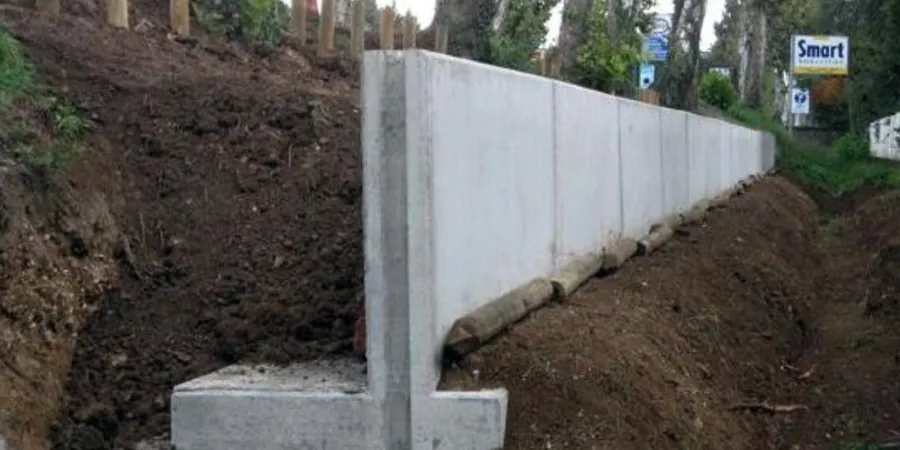
Tidal groundwater fluctuation in Bunbury can reduce effective soil strength by 30% if not included in the wall design.
Approach and scope
- Site classification per AS 2870 for reactive sites
- Limit equilibrium analysis using Bishop and Spencer methods
- Uplift verification with hydrostatic pressure diagrams
Site-specific factors
The primary geotechnical risk in Bunbury comes from the contrast between the competent limestone and the underlying soft silt layers of the Swan Coastal Plain. A retaining wall designed for a uniform soil profile may experience differential settlement when one section bears on rock and another on 3–5 metres of soft clay. We have seen this on Ocean Drive projects where the wall face tilted 80 mm in two years because the toe was founded on fill over peat. Mitigation requires deep replacement of soft strata or a piled foundation beneath the wall stem. A retaining wall design in Bunbury must account for these vertical stiffness contrasts from the first borehole log.
Regulatory framework
AS 4678-2002 (Earth-Retaining Structures), AS 2870-2011 (Residential Slabs and Footings), AS/NZS 1170.4:2002 (Structural Design Actions – Earthquake)
Related technical services
Cantilever and Counterfort Walls
Reinforced concrete walls designed for heights up to 8 m. We size the base slab and stem using factored bearing pressures from the site-specific SPT N-values typical of Bunbury sands.
Soil Nail and Shotcrete Walls
Temporary and permanent nailed walls for cut slopes in Tamala Limestone. We design nail lengths and grout bond stresses to AS 4678, with corrosion protection for the aggressive coastal environment.
Segmental Retaining Walls (SRW)
Modular block systems for residential and commercial sites. We verify global stability using the Bishop method and ensure drainage complies with the Bunbury City Council's stormwater management plan.
Typical parameters
Top questions
What soil conditions most affect retaining wall design in Bunbury?
The Tamala Limestone provides good bearing capacity, but the estuarine silts and peats along the Leschenault Inlet require deep foundations or soil replacement. Groundwater response to tidal cycles is a critical factor.
How much does a retaining wall design cost in Bunbury?
A typical geotechnical design report ranges from AU$1.830 to AU$6.480 depending on wall height, site access, and the number of investigation boreholes. The final fee reflects the complexity of the local geology.
What Australian standard governs retaining wall design in Bunbury?
AS 4678-2002 is the primary standard. For residential walls, AS 2870-2011 also applies. Seismic loads follow AS/NZS 1170.4, and we reference the WA Department of Mines guidelines for batter slopes.
Do I need a geotechnical investigation before building a retaining wall in Bunbury?
Yes. Without a borehole log and groundwater monitoring, you risk differential settlement, hydrostatic pressure build-up, or wall overturning. Council approval in Bunbury typically requires a geotechnical report.
Can I use a segmental block wall on soft ground near the estuary?
Segmental walls require a competent granular base. On the soft estuarine soils near the Leschenault Estuary, we recommend a piled foundation or Improvement before installing the block system. Otherwise, long-term settlement can exceed 100 mm.