Soils in Bunbury’s coastal strip near Koombana Bay can be markedly more permeable than the denser sands and clays found around the inner suburbs like Withers. This contrast means a blanket assumption about groundwater flow rarely holds across a single site. We use the Lefranc and Lugeon field permeability test to quantify hydraulic conductivity in the exact strata that matter for your project — whether you’re designing dewatering for a basement or assessing seepage through an existing embankment. The method suits the range of granular soils and fractured rock typical of the Swan Coastal Plain, and it gives you numbers you can take straight into your drainage or grouting calculations.
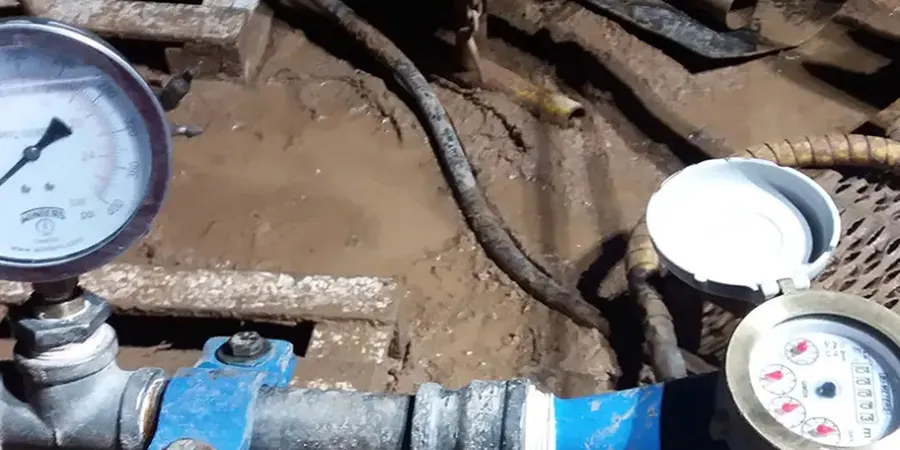
A single Lefranc test can reveal hydraulic conductivity an order of magnitude different from lab results on the same sand.
Approach and scope
Site-specific factors
Bunbury’s urban expansion over the past two decades has pushed development onto marginal land with higher water tables and variable permeability. Some subdivisions near the Leschenault Estuary sit on deposits where a thin clay cap masks an underlying sand aquifer; without In-Situ, a builder might assume low seepage and end up with a flooded excavation after the first heavy rain. The cost of a field permeability test is trivial compared to a remedial dewatering system installed under emergency conditions. We have seen sites where the Lugeon test revealed open fractures that would have consumed hundreds of cubic metres of grout, allowing the team to redesign the injection program before mobilising equipment.
Service video
This service complements our laboratory testing work for a complete project analysis.
Regulatory framework
AS 1726-2017 Geotechnical site investigations, AS 1289 Standard test method for field measurement of hydraulic conductivity, ISRM Suggested methods for Lugeon testing in rock
Related technical services
Lefranc constant-head test
For soils above the water table or in low-permeability strata, we maintain a constant water level in the borehole and measure the steady inflow rate. Ideal for sands and silty sands.
Lefranc falling-head test
Used where the water table is deep or the soil is moderately permeable. We record the rate of water-level drop in the standpipe and compute conductivity from the recession curve.
Lugeon packer test (rock)
A straddle-packer assembly isolates a test section; we inject water at three to five pressure steps (typically 0.1–1.0 MPa) and plot the flow-versus-pressure curve to classify fracture behaviour.
Multi-depth permeability profiling
Sequential tests at 1.0 m intervals down a single borehole to build a vertical conductivity profile. Useful for seepage analysis through layered profiles common in the Swan Coastal Plain.
Typical parameters
Top questions
What is the difference between the Lefranc and Lugeon tests?
The Lefranc test is used in soils (sands, silts, gravels) and measures hydraulic conductivity under a constant or falling head. The Lugeon test is designed for rock and uses stepped injection pressures to evaluate fracture transmissivity and whether the rock mass dilates or seals under pressure. Both are field permeability tests but the method selection depends on the material.
How much does a field permeability test in Bunbury cost?
A single Lefranc or Lugeon test typically costs between AU$1,090 and AU$1,750, depending on the number of test sections, borehole depth, and mobilisation to site. The price includes the test execution, data reduction, and a written report. Bulk testing for a large subdivision can reduce the per-test cost.
Do I need a field permeability test if I already have a grain-size curve?
A grain-size curve gives an estimate of permeability using empirical formulas like Hazen, but it cannot account for in-situ packing, fines migration, or stratification. The field permeability test measures the actual flow behaviour of the soil or rock mass. We often see a factor-of-ten difference between estimated and measured conductivity, especially in Bunbury’s heterogeneous coastal deposits.
How long does the test take, and does it require a dedicated borehole?
Each test section takes 1 to 4 hours depending on the permeability of the material. The test is run inside a standard geotechnical borehole (75–150 mm diameter); no separate borehole is needed. We typically schedule the test immediately after drilling and logging, so the total site visit is the same as for a routine investigation.