In Bunbury, the shallow geology along the Leschenault Estuary and coastal plain often presents soft clays and silts that demand a reliable measure of undrained shear strength. AS 1726:2017 requires that in-situ tests like the field vane shear test (VST) be conducted when undisturbed sampling of these sensitive soils proves impractical. Our team has performed dozens of VST profiles on sites near the Bunbury Port and the inner harbour, where the water table sits less than a metre below ground. The vane shear test gives you the undrained shear strength profile directly, without the disturbance inherent in tube sampling. We combine this with a consolidationanalysis when time-rate of settlement governs the foundation design.
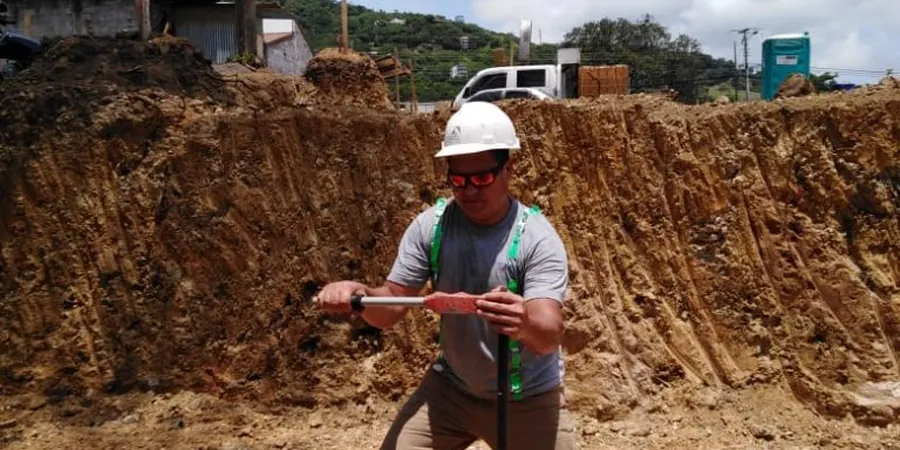
VST gives you the undrained shear strength profile directly, without the disturbance inherent in tube sampling — critical in Bunbury's soft estuarine clays.
Approach and scope
- Peak undrained shear strength (su)
- Remoulded undrained shear strength (sur)
- Sensitivity (St = su/sur)
- Depth and corrected torque values
Site-specific factors
A common mistake we see in Bunbury is relying solely on unconfined compression tests on tube samples to characterise soft clay strength. Those samples inevitably suffer from disturbance during extraction and transport, leading to an underestimation of undrained shear strength by 20% to 40%. The result is an over-designed foundation — thicker slabs, longer piles — that adds cost without improving safety. The field vane shear test avoids this error by measuring the soil in its natural stress state. When you couple VST with laboratory triaxial tests on block samples, you get a reliable design envelope rather than a guess.
Regulatory framework
AS 1726:2017 – Geotechnical Site Investigations, AS 1289.6.2.1 – Field Vane Shear Test in Saturated Fine-Grained Soils, AS 4678:2002 – Earth Retaining Structures, AS/NZS 1170:2002 – Structural Design Actions
Related technical services
Standard VST Profiling
Full-depth vane shear testing at 0.5 m or 1.0 m intervals in soft to firm clays. Includes torque calibration, data reduction, and a report with corrected su and sensitivity values. Suitable for shallow foundations, embankments, and slope stability assessments.
VST with Piezocone (CPTu) Correlation
Combined VST and piezocone soundings to develop site-specific correlation factors. We run the CPTu first to identify the stratigraphy, then perform vane tests at selected depths. The result is a continuous su profile calibrated to the vane data.
Remoulded Strength & Sensitivity Profiling
Detailed remoulded vane testing at each depth to establish sensitivity. Essential for evaluating liquefaction-induced strength loss in silty clays and for assessing the potential for strain-softening in embankment foundations.
Typical parameters
Top questions
What is the difference between field vane shear test and laboratory vane test?
The field vane shear test measures the in-situ undrained shear strength of soft clays without sample disturbance, while the laboratory vane test is performed on a retrieved sample. The field test preserves the soil fabric, pore pressure, and stress history. In Bunbury's sensitive estuarine clays, the field vane shear test typically yields 30% to 60% higher strength values than lab tests on tube samples.
How deep can the field vane shear test be performed in Bunbury?
With standard equipment we can reach up to 30 m below ground level using extension rods and a hydraulic push system. In the soft clays of the Leschenault Estuary area, the practical limit is usually around 20 m before the rod friction becomes significant. For deeper profiles we switch to a down-hole vane tool that operates inside a drill rod.
What is the typical cost of a field vane shear test in Bunbury?
For a standard VST profile at 1 m intervals to 15 m depth, the cost ranges from AU$910 to AU$2,490 depending on site access, number of test locations, and whether a drill rig is required for pre-boring through stiff crusts. This includes mobilisation, testing, calibration, and a full report with corrected strength values.
Why is sensitivity important in Bunbury's soft soils?
The soft estuarine clays around Bunbury have sensitivities ranging from 4 to 12, meaning the remoulded strength is only 8% to 25% of the peak strength. If a foundation or embankment imposes a shear stress that causes local failure, the soil can lose most of its strength almost instantly. That strain-softening behaviour has caused several slope failures along the Bunbury coastal escarpment. The field vane shear test quantifies this risk directly.
Which Australian standard governs the field vane shear test?
AS 1726:2017 – Geotechnical Site Investigations is the primary standard. Clause 5.4.3 specifies the procedure for the field vane shear test, including vane dimensions, rotation rate, and correction factors. We also adhere to AS 1289.6.2.1 for torque measurement and data reduction. For design, the VST results feed into AS 4678 for earth retaining structures and AS/NZS 1170 for structural actions.