The team mobilises a 20-tonne excavator with a smooth drum roller to prepare the reinforced soil zone on Bunbury sites. We place and compact granular fill in 300 mm lifts, wrapping each layer with geogrid reinforcement. A panel formwork system aligns the facing units before backfilling. The process follows AS 4678 for earth-retaining structures. Before the MSE wall design begins, we run a placa de carga test on the foundation subgrade to verify bearing capacity. This step prevents differential settlement behind the wall face. Bunbury's coastal geology demands careful drainage installation behind the reinforced block to avoid hydrostatic pressure build-up.
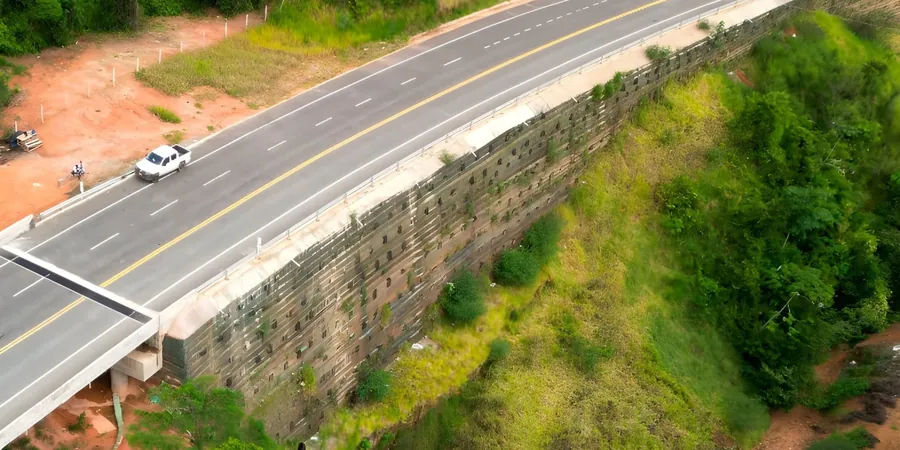
Bunbury's sandy coastal soils require careful drainage design behind MSE walls to prevent hydrostatic pressure buildup during winter rainfall events.
Approach and scope
Site-specific factors
Bunbury sits within a moderate seismic zone with a peak ground acceleration of 0.09 g for a 500-year return period. The dominant risk for MSE walls here is internal erosion of the granular fill during intense winter storms. Bunbury receives over 800 mm of rainfall annually, concentrated from May to September. Without a properly designed drainage system, water saturates the reinforced soil zone and reduces effective stress. The result can be lateral displacement of the facing panels or bulging of the wall face. We mitigate this by using clean, free-draining backfill with less than 5 percent fines and installing a geocomposite drainage strip along the wall backface.
Regulatory framework
AS 4678-2002 Earth-retaining structures, AASHTO LRFD Bridge Design Specifications (9th Edition, 2020), AS/NZS 1170.4-2007 Structural design actions – Earthquake actions, FHWA-NHI-10-024 Design and Construction of Mechanically Stabilized Earth Walls
Related technical services
Geotechnical Investigation for MSE Walls
We drill boreholes to 10 m depth behind the proposed wall alignment. Standard penetration tests and undisturbed sampling define the foundation soil profile. Laboratory testing determines the backfill friction angle and gradation for drainability assessment.
Internal and External Stability Analysis
Using limit equilibrium software, we compute factors of safety against pullout, rupture, sliding and overturning. The analysis considers surcharge loads from adjacent roads, buildings or stockpiles. Results are presented in a design report with tables and cross-sections.
Drainage and Face Panel Detailing
We specify the drainage aggregate zone, filter fabric and outlet pipe location. The facing panel connection to the geogrid is detailed to prevent corrosion at the interface. Construction drawings show every reinforcement layer and compaction requirement.
Typical parameters
Top questions
What is the typical height limit for an MSE wall in Bunbury?
Standard MSE walls in Bunbury are designed up to 12 m height without surcharge. Beyond that, we recommend a reinforced soil slope or tiered wall configuration. The limit is governed by internal stability and available right-of-way.
How does Bunbury's sandy soil affect the MSE wall design?
Clean beach sands produce high friction angles but low cohesion. The wall design relies entirely on the friction between the sand and the geogrid for internal stability. We specify a minimum backfill friction angle of 30 degrees and require compaction to 95% standard Proctor density.
Do I need a drainage system behind the MSE wall?
Yes, drainage is mandatory in Bunbury due to the high winter rainfall. We install a 300 mm thick gravel blanket with a perforated pipe at the base. A geotextile filter separates the drainage layer from the reinforced fill to prevent clogging.
What is the cost range for an MSE wall design in Bunbury?
The design fee typically ranges between AU$2.150 and AU$7.530 depending on wall height, number of load cases and site access conditions. This includes the geotechnical investigation, stability analysis and full construction drawings.
How long does the MSE wall design process take?
From borehole drilling to final report, the process takes 4 to 6 weeks. The site investigation and laboratory testing account for the first 2 weeks. Stability analysis and drawing production take the remaining time. Faster turnaround is possible for small walls under 4 m height.