Bunbury sits on the Swan Coastal Plain, where sandy soils and limestone caprock dominate the subsurface profile. Annual rainfall here exceeds 700 mm, which means compaction control is critical from day one. We perform the field density test using the sand cone method to verify that placed fill meets the specified dry density ratio. Before we even set up the cone plate, we cross-check the site's material against the reference Proctor curve from the laboratory. This test gives us the in-situ density in minutes, not hours. For projects on the Port area or near the Leschenault Estuary, we often combine this with a plate load test to validate bearing capacity under working loads.
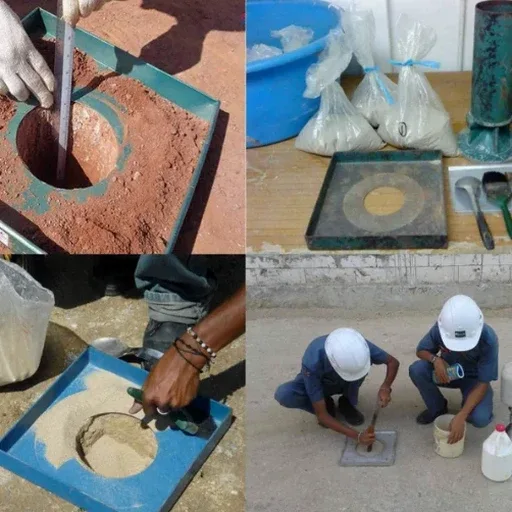
The sand cone method remains the referee test for compaction disputes in Bunbury. No radiation license needed, just a clean hole and a steady hand.
Approach and scope
- Test depth: up to 300 mm per lift
- Suitable for: sands, gravels, silts, and low-plasticity clays
- Accuracy: ±1% of dry density when performed correctly
- Equipment: sand cone apparatus, calibrated sand, balance, oven
Site-specific factors
In Bunbury's southern suburbs — around Withers and Usher — the topsoils are often loose aeolian sands with low natural density. Builders who skip compaction testing on these fills risk differential settlement within the first year. On the other hand, the heavy clay zones near Glen Iris require more passes and tighter moisture control. If the sand cone test shows densities below 95% of the standard Proctor, we stop the fill operation and rework the layer. That simple step saves homeowners and developers thousands in future slab repairs.
Service video
This service complements our laboratory testing work for a complete project analysis.
Regulatory framework
AS 1289.5.3.1: Soil compaction and density tests – Sand replacement method, AS 1289.5.4.1: Nuclear gauge method (used for cross-check), AS 3798: Guidelines on earthworks for commercial and residential developments
Related technical services
Standard Sand Cone Density Test
In-situ dry density and moisture content on compacted fill. We follow AS 1289.5.3.1 to the letter. Reports include degree of compaction, moisture deviation, and recommendations for rework if needed.
Compaction Control for Road Subgrades
Specific to pavement layers and subgrades in Bunbury's road projects. We test each lift — typically 200 to 300 mm — and compare results against the project specification. Density readings are delivered within 24 hours.
Pre- and Post-Compaction Verification
For bulk earthworks and structural fill. We run initial Proctor curves on the source material, then use the sand cone method to confirm the placed density. This service is common on residential subdivisions in Eaton and Dalyellup.
Typical parameters
Top questions
How much does the sand cone field density test cost in Bunbury?
The typical cost per test ranges from AU$160 to AU$200, depending on the number of tests per day and site access conditions. Volume discounts apply for projects requiring 10 or more tests. We include the full report with each test.
What is the difference between the sand cone test and a nuclear density gauge?
The sand cone test is a direct volumetric method — it physically measures the volume of the test hole. The nuclear gauge uses gamma radiation to estimate density indirectly. The sand cone is the reference method for disputes because it does not rely on calibration curves or radiation source decay. It is slower but more defensible in court.
Can the sand cone test be used on wet or saturated soils?
The reference range for this service in Bunbury is AU$160 - AU$200. The final price depends on the project scope and volume.
How many sand cone tests are required per earthworks area?
AS 3798 recommends a minimum of one test per 500 m² of compacted area per lift, or as specified by the project engineer. For small residential lots, we typically do three to five tests per slab footprint. For large subdivisions, we test at a frequency of one per 1,000 m² per layer.