The Australian Standard AS 1726:2017 sets the benchmark for geotechnical site investigations, and in Bunbury it is particularly relevant due to the city's complex subsurface conditions. Much of the urban area sits on sandy soils overlying compressible clay layers, remnants of the Leschenault Estuary system. A solid geotechnical analysis for soft soil tunnels in Bunbury must account for these variable strata, from the coastal dune sands near Koombana Bay to the alluvial deposits inland. We integrate site-specific borehole data with laboratory testing to produce reliable ground models that support safe tunnel design.
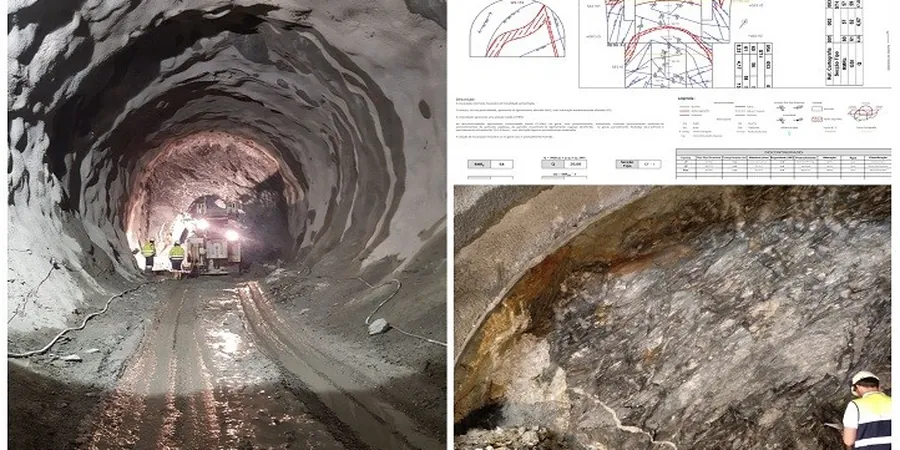
In soft ground tunnelling, the stiffness and strength of the shallow sand layer often control the settlement trough behaviour.
Approach and scope
- SPT at 1.5 m intervals to record blow counts and recover disturbed samples for index testing.
- Piezometer installation for monitoring groundwater response during excavation.
- Downhole shear wave velocity profiling using a seismic cone, particularly useful for assessing small-strain stiffness in the soft layers.
Site-specific factors
A recent sewer tunnel drive beneath Wittenoom Street encountered a sudden change from dense sand to a soft clay lens, causing the TBM to sink 40 mm off alignment before corrections were made. That incident cost two weeks of schedule and required a compensation grouting programme. The biggest risk in Bunbury is the lateral variability of the soil profile; a borehole 20 metres apart can show completely different conditions. Without a thorough geotechnical analysis for soft soil tunnels in Bunbury, contractors face unexpected ground loss, surface settlement damaging adjacent infrastructure, and potential face instability during excavation.
Service video
Regulatory framework
AS 1726:2017 Geotechnical site investigations, AS 4678:2002 Earth-retaining structures, AS/NZS 1170.0:2002 Structural design actions – general principles, FHWA-NHI-05-037 (soft ground tunnel design)
Related technical services
Borehole Drilling & Sampling
Continuous core drilling with SPT and undisturbed sampling at depths up to 30 m, covering the full tunnel alignment.
Laboratory Testing
Triaxial CU/UU, oedometer consolidation, and Atterberg limits on cohesive samples to define strength and compressibility parameters.
Groundwater Monitoring
Installation of standpipe piezometers and vibrating wire sensors to track pore pressures during tunnel advance.
Numerical Modelling
2D/3D finite element analysis using Plaxis or FLAC to predict settlements, lining loads, and face stability for various excavation methods.
Typical parameters
Top questions
What makes Bunbury's ground conditions different for tunnelling?
Bunbury's geology features a shallow sand layer over soft estuarine clays that are highly compressible. The water table is high, often less than 2 m deep, which reduces effective stress and increases the risk of face collapse during tunnel excavation.
How is soil stiffness measured for tunnel design in Bunbury?
We use downhole vs30/" data-interlink="1">shear wave velocity profiles (seismic cone or MASW) to obtain small-strain stiffness (G0), plus triaxial tests with local strain measurement for stiffness degradation curves. These data are essential for settlement prediction in soft ground.
What is the typical cost range for a geotechnical analysis for soft soil tunnels in Bunbury?
A comprehensive study covering 4–6 boreholes plus lab testing and numerical modelling typically ranges from AU$6,620 to AU$28,450, depending on alignment length and required testing scope.
Do you provide instrumentation for monitoring during tunnel construction?
Yes, we install settlement markers, inclinometers, and piezometers along the tunnel route. Real-time data logging allows the contractor to adjust advance rates or apply compensation grouting if movements exceed trigger levels.