Bunbury grew fast as a port town, and a lot of that early development happened on the sandy coastal plain between the Leschenault Estuary and the Koombana Bay shoreline. Back then, builders relied on local knowledge rather than lab data. These days we know better. The sand here is well-graded in some spots and uniformly fine in others, with clay lenses that shift the whole soil behavior. That's why grain size analysis (sieve + hydrometer) is non-negotiable before any slab or footing design. We've processed hundreds of samples from the Koombana Drive corridor and the residential areas around Withers, and the variation in fines content alone can change your foundation recommendation entirely. Before we even touch a sieve, we often run a clasificación de suelos to cross-check visual descriptions against lab results, which saves time on site re-classifications later.
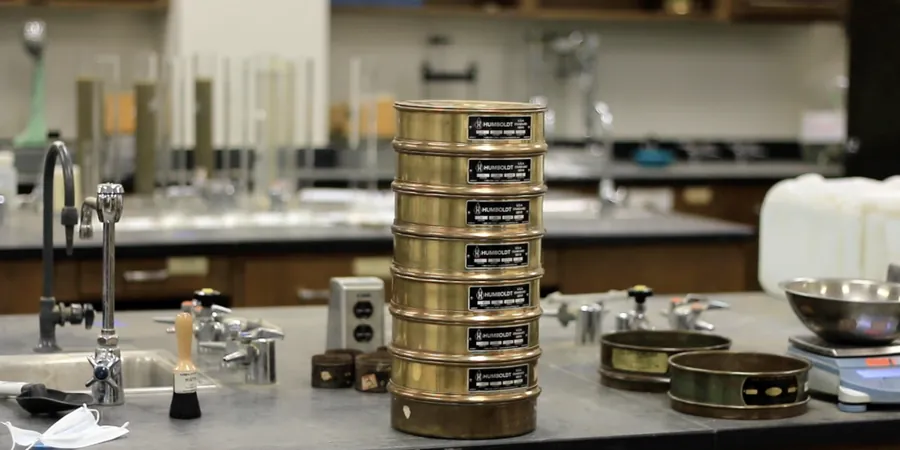
For Bunbury's coastal sands, the fines content below 75 µm often dictates whether your site needs drainage or deep fill before slab construction.
Approach and scope
- D10, D30, D60 coefficients for uniformity and curvature
- Percent passing 75 µm sieve for fines classification
- Clay fraction (<2 µm) via hydrometer for plasticity assessment
Site-specific factors
The sandy soils around Bunbury's inner harbour and the Pelican Point area often contain shell fragments and carbonate particles that break down during hydrometer testing, skewing the fines curve. If you don't account for that, the soil classification shifts from a non-plastic sand to a low-plasticity silt on paper, even though the engineering behaviour is still sand-dominated. We've seen foundation designs over-specified because of that artefact. Another common issue is the shallow water table: during wet sieving, samples with high natural moisture content can clump and retain fines on the coarser sieves, giving a false coarse fraction. We pre-dry those samples carefully at 60°C to avoid altering the mineralogy. Missing these details means you could end up with a compaction spec that doesn't match the real soil response on site.
Regulatory framework
AS 1726-2017 Geotechnical site investigations (clause 5.2 particle size distribution), AS 1289.3.6.1 Standard test methods for particle-size distribution (gradation) of soils using sieve analysis, AS 1289 Standard test method for particle-size distribution (gradation) of fine-grained soils using the sedimentation (hydrometer) analysis
Related technical services
Dry sieve analysis (coarse soils)
For sands and gravels with less than 5% fines, we use mechanical sieve shakers with 8-inch sieves from 19 mm down to 75 µm. Results include cumulative percent passing and a grading curve plotted to AS 1726 format. Typical turnaround is 48 hours for clean sands.
Wet sieve + hydrometer (fine soils)
When fines exceed 5%, we wash the sample through a 75 µm sieve first, then run the retained fraction on dry sieves and the passing fraction on a standard hydrometer (ASTM 152H) with readings at 1, 2, 5, 15, 30, 60, 120, 240, 480, and 1440 minutes. This gives the full clay-silt-sand split.
Combined gradation with plasticity correlation
For critical layers like the foundation subgrade in Bunbury's coastal fill, we combine the full PSD curve with Atterberg limits and linear shrinkage to classify soil as per the Unified Soil Classification System (USCS) and AS 1726 Table 5.2. This is the standard deliverable for structural engineering reports.
This service complements our laboratory testing work for a complete project analysis.
Typical parameters
Top questions
What is the difference between sieve analysis and hydrometer analysis?
Sieve analysis separates particles larger than 75 µm by passing the soil through a stack of progressively finer sieves. Hydrometer analysis measures the settling velocity of particles smaller than 75 µm in a water column, using Stokes' law to calculate the equivalent spherical diameter. The two methods together give a continuous particle size curve from gravel to clay, which is required for proper soil classification under AS 1726.
How much does grain size analysis cost in Bunbury?
For a standard combined sieve and hydrometer test on one sample, the cost typically ranges from AU$150 to AU$280 depending on whether the sample needs pre-treatment (drying, dispersant, or organic removal). Bulk discounts apply for subdivision projects with five or more samples from the same site. Contact us for a quote based on your specific sample count and required turnaround.
Why is grain size analysis important for Bunbury's sandy soils?
Bunbury's coastal sands vary from well-graded dune sand to uniformly fine beach sand with variable shell content. Without a full PSD curve, you can't accurately estimate drainage characteristics, compaction behaviour, or frost susceptibility. In areas like the Leschenault Estuary foreshore, the fines content can jump from 3% to 18% within 50 metres, which changes both the permeability and the shrink-swell potential of the subgrade.
What sample size do you need for grain size analysis?
For standard sieve analysis up to 19 mm particles, we require a minimum of 500 g of dry soil. If the sample contains gravel-size particles (up to 75 mm), we need 2–3 kg to ensure a representative split. For hydrometer analysis alone, a 100 g subsample of the passing-75 µm fraction is sufficient, but we prefer to start with a full 500 g sample so we can run the sieve portion simultaneously.
Can grain size analysis detect clay minerals in Bunbury soils?
The hydrometer test measures the percentage of particles smaller than 2 µm (clay fraction) but does not identify the specific clay mineral type. For that, you would need X-ray diffraction (XRD) or Atterberg limits. However, the combination of high clay fraction (>15%) with low plasticity index (<15%) typically indicates kaolinite or illite, which are common in Bunbury's residual soils from the Bassendean Sand formation. For high-plasticity clays, we recommend paired Atterberg tests.