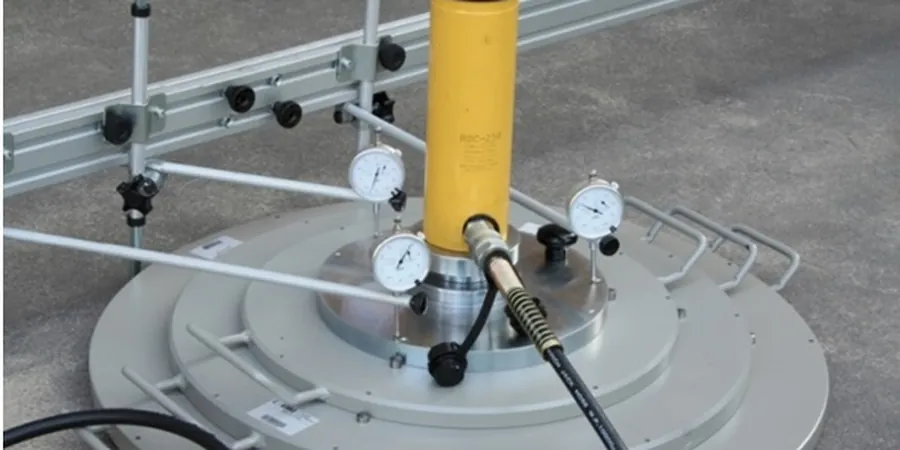
The plate load test (PLT) setup in Bunbury typically uses a hydraulic jack, a calibrated load cell, and a steel plate between 300 mm and 600 mm in diameter, placed directly on the prepared subgrade. A reaction beam or weighted platform provides the counterforce, while three dial gauges measure settlement with an accuracy of 0.01 mm. This in-situ test is particularly relevant in the sandy soils of the Swan Coastal Plain, where the water table sits at a shallow depth of 2–4 m in many areas. Before mobilising the equipment, a borehole with standard penetration testing helps identify the soil profile and locate the correct test horizon, ensuring the plate load test yields representative results for the foundation design.
A single plate load test in Bunbury’s coastal sands can reduce foundation over-design by 15% to 25% compared to table-based estimates alone.
Approach and scope
Site-specific factors
The coastal geology around Bunbury includes loose to medium dense dune sands underlain by the Tamala Limestone formation. These sands can undergo rapid densification under cyclic loading, while the limestone itself may have solution cavities that reduce local bearing capacity. A plate load test (PLT) carried out at the wrong elevation — for instance, directly on a thin sand layer that sits above a cavity — may give a misleading high modulus. The risk is that the foundation then settles unevenly as the cavity collapses under sustained load. For this reason, the test location should be guided by a prior geophysical survey or exploratory boreholes, and the load-settlement curve must be analysed against the bearing capacity verification criteria in AS 4678.
Regulatory framework
AS 4678:2002 (Earth-retaining structures), AS 1289 (Field bearing capacity), AS 1726 (Geotechnical site investigations)
Related technical services
Conventional PLT on subgrade
Standard 300 mm or 450 mm plate test on prepared subgrade at foundation level, with incremental loading up to 1.5 times design pressure and full settlement recording. Suitable for shallow foundations and pavement subgrade verification.
PLT on compacted fill
Test performed on engineered fill layers (typically 150–300 mm thick) to confirm that the achieved compaction meets the design modulus of subgrade reaction. Includes density correlation with a sand replacement test.
Cyclic plate load test
Repeated loading cycles at a frequency of 0.1–0.3 Hz to simulate traffic or machinery loading. Used for pavement bases and crane-pad foundations where repeated stress can cause progressive settlement.
Typical parameters
Top questions
How is the plate load test performed in Bunbury's sandy soils?
A steel plate is placed on a levelled surface and loaded incrementally using a hydraulic jack. Settlement is recorded at each stage until the rate drops below 0.25 mm per hour. In loose sands, a pre-load cycle may be applied to seat the plate and minimise bedding error.
What is the difference between plate load test and SPT?
The plate load test measures the actual load-settlement behaviour of the soil at a specific depth, giving the modulus of subgrade reaction and bearing capacity directly. SPT (standard penetration test) measures a blow count that is correlated to relative density and is used for stratigraphic profiling. PLT is a performance test; SPT is a classification test.
What does a plate load test cost in Bunbury?
The typical cost for a standard plate load test in Bunbury ranges from AU$1,180 to AU$2,080, depending on the plate size, number of load cycles, and site access conditions. Additional charges apply if a reaction beam needs to be mobilised for heavy loads.
How long does a plate load test take on site?
A single test with three load-unload cycles takes approximately 4 to 6 hours on site, including setup, loading, and teardown. For projects requiring multiple test locations, the team can complete up to two tests per day if the site is within a 30-minute drive of Bunbury.
Can the plate load test be used on Tamala Limestone?
Yes, but the limestone surface must be prepared by removing the weathered crust and any loose debris. The plate must be seated on a thin sand layer (10–20 mm) to ensure uniform contact. The test then gives the modulus of the intact limestone, which can be 100–300 MPa in the Bunbury region.