Bunbury sits on the Swan Coastal Plain, where sandy soils overlie a shallow limestone caprock in many suburbs. Groundwater can sit just two metres below surface after winter rains. That combination makes flexible pavement design a careful balancing act. We have to ensure the pavement structure drains freely while still supporting the heavy truck traffic that serves the port and timber industry. Before we propose any asphalt thickness or base course depth, we run a full site investigation including CBR testing on the subgrade. In low-lying areas near the Leschenault Estuary, we often need to improve the subgrade with a lime-cement stabilization layer to deal with the high plasticity clay pockets. Every design we produce references the local rainfall intensity and the specific traffic spectrum for Bunbury roads.
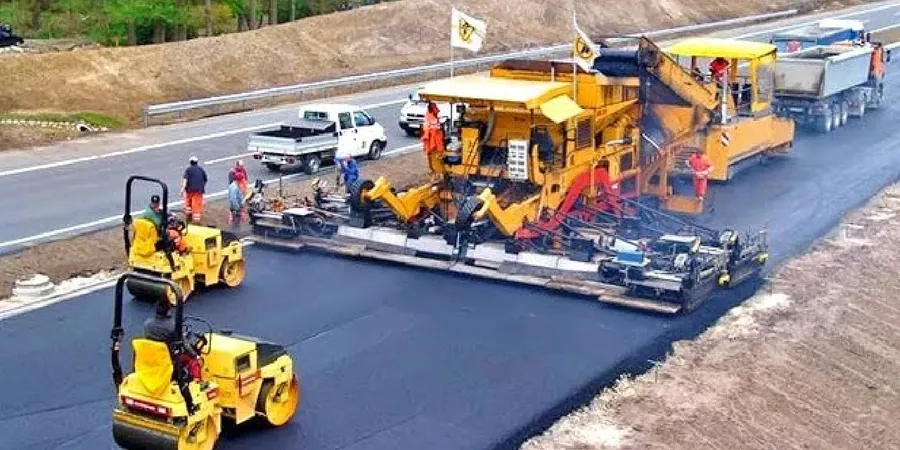
Bunbury’s shallow groundwater and sandy subgrade demand a drainage-first approach to avoid premature pavement failure from moisture entrapment.
Approach and scope
- Subgrade CBR at soaked and unsoaked conditions
- Design traffic loading in equivalent standard axles (ESA)
- Granular base and subbase material compliance with MRWA Specification 501
- Asphalt modulus and fatigue life under repeated loading
Site-specific factors
The most common mistake we see in Bunbury is designing the pavement structure without verifying the actual subgrade moisture condition. Developers often assume dry summer CBR values, then the pavement fails within two winters. The sandy topsoil drains fast but the silty clay subgrade below holds water. That trapped moisture weakens the base course from below, causing rutting and cracking. We always insist on soaked CBR tests and a groundwater monitoring program before finalizing any flexible pavement design for Bunbury projects. It costs a bit more upfront but saves thousands in premature rehabilitation.
Regulatory framework
Austroads Guide to Pavement Technology Part 2 (2021), MRWA Specification 501 – Pavements, AS 1726 – Geotechnical Site Investigations, AS 1289.6.1.1 – Standard Test Method for CBR
Related technical services
Subgrade Investigation & CBR Testing
Soaked and unsoaked CBR tests on undisturbed and remoulded samples from boreholes and test pits across Bunbury.
Traffic Load Analysis
Calculation of design ESA based on weigh-in-motion data and traffic projections for local roads and industrial access.
Pavement Structural Design
Layer thickness design using CIRCLY or equivalent software, with sensitivity analysis for wet subgrade conditions.
Drainage & Subgrade Improvement
Specification of drainage blankets, edge drains, and stabilization treatments tailored to Bunbury soil types.
This service complements our laboratory testing work for a complete project analysis.
Typical parameters
Top questions
What is the typical cost for a flexible pavement design in Bunbury?
For a standard local road project in Bunbury, the cost ranges between AU$2.920 and AU$7.370 depending on the number of test pits, traffic analysis complexity, and the need for soaked CBR testing. Large industrial access roads with heavy truck traffic sit at the higher end of that range. Contact us for a project-specific quote.
How does Bunbury's sandy soil affect pavement design?
Bunbury's sandy subgrade offers good drainage but low cohesion, which means the base course can shift under load if not confined properly. We often specify a geotextile separation layer and increase the base thickness to spread loads. The sand also makes it harder to achieve proper compaction near the limestone caprock layers.
Do I need a soaked CBR test for a Bunbury pavement design?
Yes. Bunbury experiences prolonged winter wet seasons, and the subgrade CBR can drop by more than 50% from its dry value. Without soaked CBR data, your design will underestimate the required pavement thickness and risk early failure. We always run soaked tests on at least three samples per project.