Bunbury sits atop a mix of Quaternary sands and Tamala Limestone, with groundwater often encountered within 3-5 m of the surface. These conditions make conventional piling challenging — driven piles can fracture the limestone and displacement methods may disturb adjacent structures. Micropile design in Bunbury offers a low-vibration, high-capacity alternative that transfers structural loads directly to competent strata. We combine local geotechnical knowledge with numerical modelling to size micropiles that respect the variable rockhead depth. Before finalising the design, we often cross-check against the capacity of nearby existing piles to calibrate our assumptions for the site-specific ground profile.
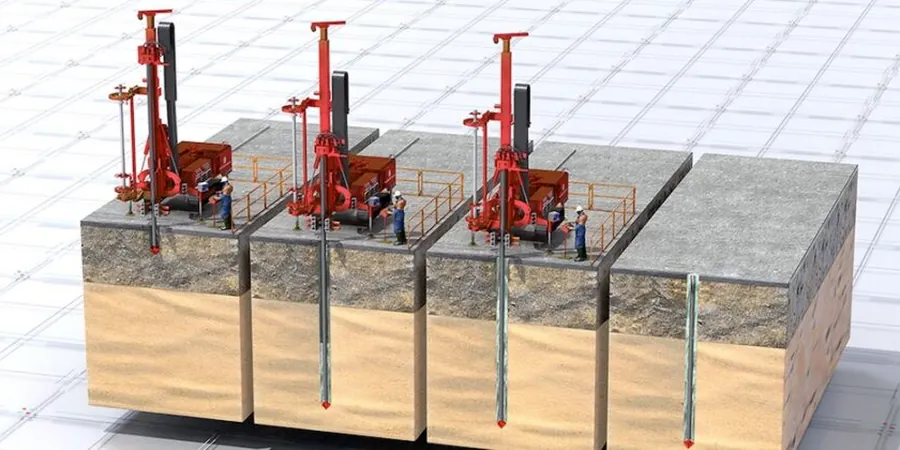
Micropile design in Bunbury must account for variable rockhead depth and aggressive groundwater — a standard code check is rarely enough.
Approach and scope
- Axial and lateral load analysis per AS 1726 and AS 4678
- Buckling checks in soft upper sands using finite difference methods
- Group efficiency calculations for pile caps with centre-to-centre spacing under 3 diameters
Site-specific factors
AS 4678:2002 and AS 1726:2017 set the framework for micropile design in Australia, but in Bunbury the interaction between the limestone karst and the overlying sand is the primary risk. Voids or solution cavities in the limestone can cause sudden grout loss during installation, leading to incomplete bond zones. Without a detailed borehole record across the entire footprint, a pile may land on a thin limestone bridge that collapses under load. We mitigate this by specifying sacrificial test piles and performing static load tests to failure on at least two locations per project, confirming that the design assumptions hold for Bunbury's variable subsurface.
Regulatory framework
AS 1726:2017 – Geotechnical site investigations, AS 4678:2002 – Earth-retaining structures, AS 2159:2009 – Piling – design and installation, FHWA-NHI-05-042 – Micropile design and construction
Related technical services
Concept and Detailed Design
Load take-downs, strut and tie models, and LTB analysis using industry-standard software. We produce construction-ready drawings with bar schedules and grout mix specifications.
Verification and Load Testing
Bi-directional and static compression tests to confirm bond stress and structural capacity. We interpret the results and adjust the design if the rockhead depth differs from the borehole log.
Corrosion Protection and Durability
Selection of coating systems, sacrificial steel thickness, and cement type based on groundwater chemistry. We comply with AS 2159 exposure classifications for Bunbury's coastal environment.
This service complements our laboratory testing work for a complete project analysis.
Typical parameters
Top questions
What is the typical design working load for micropiles in Bunbury?
For the sandy and limestone profiles around Bunbury, individual micropiles are usually designed for working loads between 300 kN and 1 200 kN, depending on the bond zone length and the rock mass quality. Higher capacities are achievable with larger bar diameters and longer bond lengths into competent limestone.
How does the shallow water table affect micropile design in Bunbury?
The water table, often encountered at 3-5 m depth, requires tremie grouting and a minimum cement content of 450 kg/m³ to avoid washout. It also increases the corrosion risk, so we specify a minimum 50 mm grout cover and, for permanent applications, epoxy-coated bars.
Can micropiles be installed in tight access areas in central Bunbury?
Yes. Micropile drilling rigs are compact — typically under 1.5 m wide — and can work inside existing buildings or alongside heritage structures in the Bunbury CBD. The low-vibration installation method also minimises disturbance to adjacent footings and services.