A three-story commercial development on Sandridge Road recently stalled mid-excavation when the contractor hit a layer of soft estuarine clay not shown on the original geotechnical brief. That kind of surprise costs time and money. A proper soil mechanics study in Bunbury would have mapped that clay horizon before the first bucket broke ground. Bunbury sits on the Swan Coastal Plain, where the geology shifts from coastal sand dunes to alluvial deposits within a few hundred meters. This variability means a single borings program rarely tells the full story. We combine test pits, SPT, and laboratory classification to build a reliable ground model for your site.
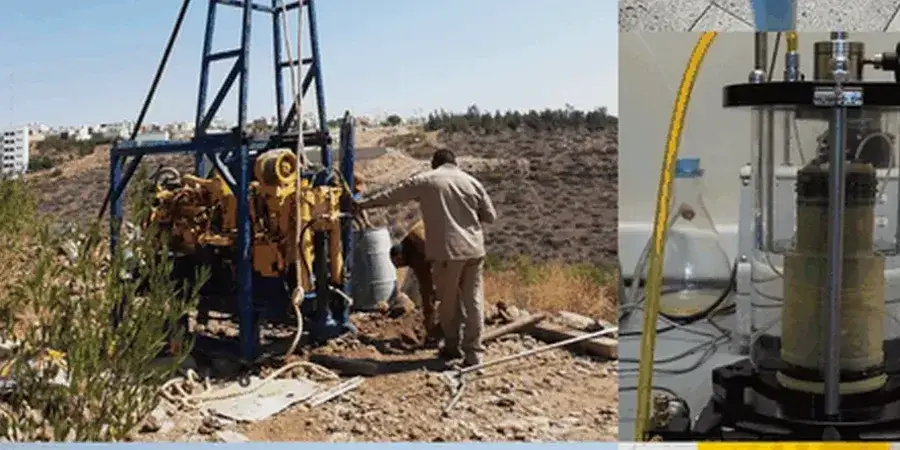
Bunbury's coastal geology can hide soft estuarine clays just below the sand — a soil mechanics study is the only way to find them before construction.
Approach and scope
- Site classification using shallow test pits and boreholes
- In-situ density and moisture profiling
- Laboratory tests for Atterberg limits and particle size distribution
- Consolidation testing for settlement estimates on compressible layers
Site-specific factors
Bunbury sits at roughly 4 metres above sea level and receives over 700 mm of rain annually, mostly between May and September. That winter rainfall raises the water table close to the surface in low-lying suburbs like Withers and South Bunbury. High groundwater reduces effective stress in the soil and can trigger differential settlement under shallow footings. A soil mechanics study in Bunbury identifies these saturated zones early. We measure groundwater levels during drilling and run consolidation tests to predict how much the ground will settle under your proposed loads. Ignoring the water table here is a common design error that leads to cracked slabs and costly repairs.
Regulatory framework
AS 1726 – Geotechnical Site Investigations, AS 4678 – Earth Retaining Structures, AS/NZS 1170.0 – Structural Design Actions
Related technical services
Site Investigation & Sampling
Boreholes, test pits, and undisturbed sampling to classify the soil profile and locate groundwater. We follow AS 1726 procedures for logging and sample retrieval.
Laboratory Testing Suite
Moisture content, Atterberg limits, particle size distribution, and direct shear. All tests performed in a NATA-accredited facility with ISO 17025 quality management.
Foundation Design Parameters
Bearing capacity, settlement estimates, and modulus of subgrade reaction for shallow and deep foundations. Results reported in a geotechnical design brief.
Earthworks & Pavement Assessment
Optimum moisture content, maximum dry density (modified Proctor), and CBR values for road subgrades and fill compaction. Suitable for subdivision and road projects.
Typical parameters
Top questions
How much does a soil mechanics study in Bunbury cost?
The typical cost for a standard residential or small commercial soil mechanics study in Bunbury ranges between AU$4,990 and AU$7,450, depending on the number of boreholes, depth of investigation, and laboratory tests required. A larger industrial site with multiple test pits and advanced triaxial testing will be at the higher end. Contact our team for a fixed-price quote tailored to your project scope.
What is the difference between soil mechanics study and a simple site classification?
A site classification (AS 2870 Class A to P) is a simplified assessment mainly for residential slabs. A soil mechanics study goes much deeper: it includes in-situ strength testing (SPT, shear vane), laboratory classification, consolidation curves, and design parameters for foundations, retaining walls, and pavements. It is required for commercial buildings, multi-storey structures, and any site with known geotechnical risks like soft clays or high groundwater.
How long does a soil mechanics study take in Bunbury?
The fieldwork can be completed in one to three days depending on the number of boreholes and site access. Laboratory testing takes another five to ten working days, and the final report is issued within two weeks of sample receipt. We can expedite the timeline for urgent projects by prioritising the lab schedule.
What tests are included in a standard soil mechanics study for a Bunbury building site?
For a typical building site in Bunbury we include: SPT in each borehole, undisturbed tube sampling, moisture content, Atterberg limits, particle size distribution, and a modified Proctor compaction test. If the soil contains significant fines, we add a consolidation test (oedometer) to check settlement potential. All tests follow AS 1726 and ASTM standards.