A commercial development on Blair Street showed floor slab cracking just six months after handover. We were called in to determine why. The culprit was differential settlement between a zone of loose estuarine sand and a stiff clay lens. For Bunbury, where the Leschenault Estuary and coastal dunes create rapid soil changes, a standard site classification is rarely enough. We combine borehole logs with settlement modelling to map where the ground will move unevenly. Before pouring footings, we recommend a capacidad de carga test to confirm bearing layers, and a clasificacion suelos profile to identify collapsible zones.
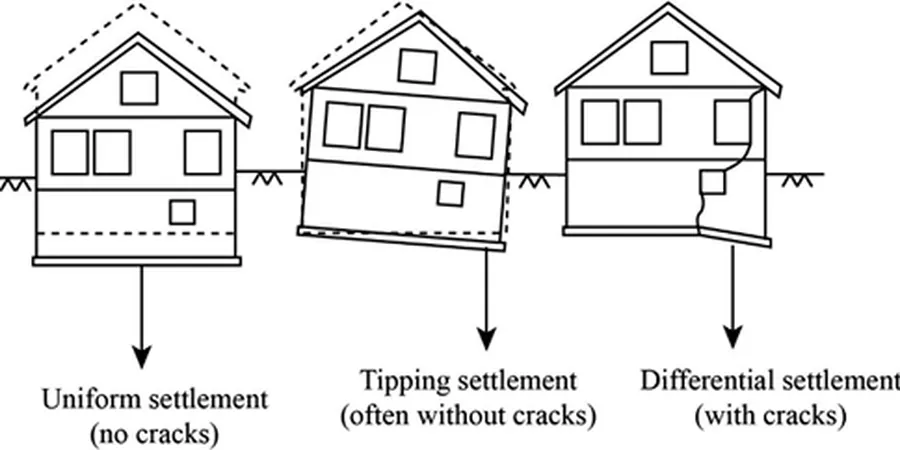
A 15 mm differential across a column grid can crack a reinforced concrete slab. We map where that risk lives.
Approach and scope
- Consolidation testing on clay layers to estimate primary and secondary settlement
- Plate load tests on sand lenses to confirm immediate settlement under working loads
- Numerical modelling with Plaxis 2D for complex soil-structure interaction
Site-specific factors
Bunbury sits on Pleistocene dune sands overlying the Guildford Formation clay. The water table is shallow near the coast, often less than 2 m below ground. When a clay layer compresses unevenly under load, the rigid structure above cracks. The risk spikes in winter when the perched water table rises and softens the clay. We also see old drainage channels filled with loose sand that settle more than the adjacent natural ground. Ignoring these localised pockets leads to cosmetic damage and structural distress. Our differential settlement analysis identifies each soft zone before the foundation is designed, so remedial work is avoided.
Regulatory framework
AS 1726-2017 Geotechnical site investigations, AS 4678-2002 Earth retaining structures (settlement criteria), AS/NZS 1170.0-2002 Structural design actions – general principles
Related technical services
Oedometer consolidation testing
One-dimensional consolidation tests on undisturbed samples from clay layers. We report mv, cv, and preconsolidation pressure for each stratum.
Plate load tests for immediate settlement
Field plate load tests on sand or fill layers to measure immediate settlement modulus. Results feed directly into footing design calculations.
Numerical settlement modelling
2D finite element analysis using Plaxis to simulate differential movement between adjacent footings. Includes sensitivity analysis for variable soil layers.
Typical parameters
Top questions
What causes differential settlement in Bunbury soils?
The main causes are lenses of soft estuarine clay interbedded with loose dune sands, shallow water tables that soften clays seasonally, and old filled drainage channels that compress more than natural ground. Each condition creates uneven bearing response under load.
How much does a differential settlement analysis cost in Bunbury?
The cost ranges between AU$1.110 and AU$3.100 depending on the number of boreholes, laboratory tests, and modelling complexity. A typical single-storey commercial site with three boreholes and consolidation testing falls in the middle of that range.
What is the difference between total settlement and differential settlement?
Total settlement is the overall vertical movement of a foundation. Differential settlement is the difference in movement between two points on the same structure. A 15 mm total settlement might be harmless if uniform, but a 15 mm differential across a column bay can crack slabs and jam doors.
When should I order a settlement analysis for a Bunbury project?
Order it during the geotechnical site investigation phase, before foundation design. If the site has variable soil profiles, existing fill, or a high water table, the analysis becomes critical. Waiting until after cracking appears means remedial costs that could have been avoided.