Bunbury’s coastal setting, with its shallow water table and soft alluvial deposits along the Leschenault Estuary, creates unique challenges for foundation design. The oedometer consolidation test is your primary tool for predicting long-term settlement under load. We perform this test in a NATA-accredited laboratory, following AS 1289.6.6.1 to measure pre-consolidation pressure, compression index (Cc), and coefficient of consolidation (Cv). Understanding these parameters early helps avoid differential settlement in structures like the Bunbury Centrepoint redevelopment. For projects on sensitive clays, we often combine oedometer data with a plate load test to validate field behaviour, ensuring your design assumptions hold up under real conditions.
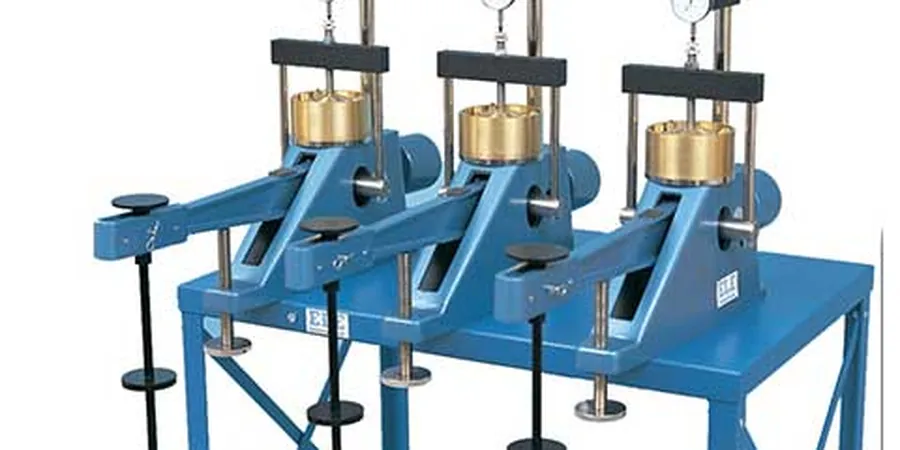
A single oedometer test on Bunbury's estuarine clays can cut settlement prediction uncertainty by up to 40% compared to empirical correlations alone.
Approach and scope
- Specimen preparation from undisturbed tube samples (75 mm or 100 mm diameter)
- Incremental loading up to 3200 kPa, with settlement readings at each stage
- Determination of Cc, Cs (swelling index), and Cv for primary consolidation
- Secondary compression index (Ca) for creep-sensitive layers
Site-specific factors
One common mistake in Bunbury is skipping the oedometer consolidation test on soft clay layers deeper than 6 metres. Builders assume the sandier surface soils carry the load, but the underlying estuarine mud compresses slowly over years, causing progressive differential settlement. Without Cc and OCR data, your settlement predictions are guesses. For a residential subdivision near Vittoria Heights, ignoring this test led to 150 mm of post-construction settlement in under two years. The lesson is clear: if your site lies within the Swan Coastal Plain’s alluvial fringe, the oedometer consolidation test is non-negotiable for risk management.
Regulatory framework
AS 1289.6.6.1:2020 — Methods of testing soils, determination of consolidation properties, AS 1726:2017 — Geotechnical site investigations (sampling and test requirements), AS 1289.6.6.1/D2435M — Standard test method for one-dimensional consolidation properties (used in parallel for international projects)
Related technical services
Standard Oedometer Test (Incremental Loading)
Full incremental loading from 12.5 to 3200 kPa, measuring Cc, Cs, Cv, and OCR. Suitable for alluvial, estuarine, and lacustrine clays. Includes preparation of undisturbed samples and detailed e-log p curve.
Constant Rate of Strain (CRS) Consolidation Test
Faster alternative for low-permeability clays. Provides continuous stress-strain data. Especially useful for Bunbury’s organic silts where incremental tests take weeks.
Swelling/Collapse Under Load (Wetting Test)
Measures heave potential for expansive soils. Critical for sites near the Leschenault Inlet where seasonal moisture changes are significant.
Consolidation with Pore Pressure Measurement
Back-pressure saturation and pore pressure dissipation monitoring. Provides u-t curves for advanced consolidation modelling. Ideal for deep foundations in Bunbury’s soft zones.
Typical parameters
Top questions
How long does an oedometer consolidation test take for Bunbury clays?
For typical estuarine silty clays in Bunbury, a standard incremental loading test takes 7 to 10 days per specimen. CRS tests can reduce this to 2–3 days. We always advise factoring in the time for sample transport and preparation.
What is the cost range for an oedometer consolidation test in Bunbury?
The typical cost for a single oedometer consolidation test in Bunbury ranges from AU$280 to AU$720, depending on the number of load increments, specimen size, and whether pore pressure measurement is included. Bulk discounts apply for multiple specimens.
Can you run an oedometer test on disturbed or remoulded samples?
No — the oedometer consolidation test requires undisturbed tube samples (preferably 75 mm diameter) to preserve the soil’s fabric and stress history. Remoulded samples will not give reliable Cc or OCR values. We can help arrange proper sampling on your Bunbury site.
How do I know if my Bunbury site needs an oedometer consolidation test?
If your site has soft clay or silt layers deeper than 3 metres, or if the proposed load exceeds 50 kPa, an oedometer consolidation test is strongly recommended. Indicators include high natural moisture content (>60%), low SPT N-values (<4), or known settlement issues on neighbouring properties.