Bunbury sits on the Swan Coastal Plain, with an average elevation of just 5 meters above sea level and a Mediterranean climate that brings dry summers and wet winters. This coastal setting produces a varied subsurface: sand dunes, estuarine deposits, and occasional clay lenses. For projects here, the flat dilatometer test (DMT) excels at profiling these layered soils quickly. It provides key deformation parameters — constrained modulus (M), horizontal stress index (Kd), and material index (Id) — without the need for drilling fluids or heavy rigs. Before finalizing foundation design, many local engineers pair DMT results with a standard penetration test (SPT) to cross-verify strength data, or use cone penetration testing (CPT) where continuous stratigraphic logs are preferred.
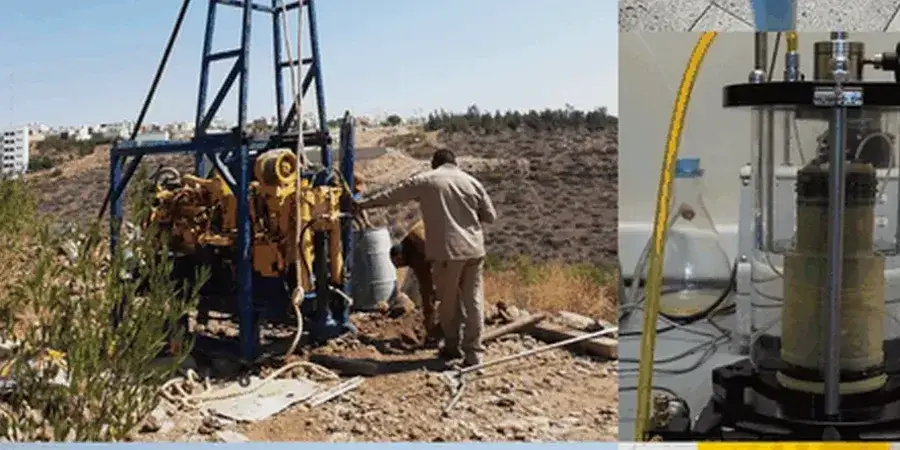
A single DMT profile can replace several days of conventional sampling while delivering superior data on soil stiffness and in-situ stress history.
Approach and scope
Site-specific factors
Bunbury's coastal humidity and shallow water table — often within 1–2 meters of the surface — create conditions where soil behavior changes rapidly with seasonal moisture. Ignoring these variations can lead to underestimating settlement in fine-grained deposits or overestimating bearing capacity in sands during dry months. The DMT's ability to measure in-situ lateral stress and stiffness at multiple depths helps engineers account for these fluctuations. When used alongside a pressuremeter test for modulus validation, the combined dataset reduces design uncertainty significantly.
Regulatory framework
AS 1289.6.5.2: Standard Test Method for Performing the Flat Plate Dilatometer, AS 1726:2017: Geotechnical Site Investigations, AS 4678:2002: Earth Retaining Structures
Related technical services
Standard DMT Profiling
Continuous vertical profiling at 0.2 m intervals from ground surface to target depth. Includes real-time data acquisition and on-site preliminary interpretation.
Seismic DMT (SDMT)
Combined flat dilatometer test with downhole seismic module to measure shear wave velocity (Vs) alongside dilatometer parameters. Ideal for dynamic site response analysis.
DMT for Settlement Analysis
Focused data collection and interpretation for immediate and consolidation settlement predictions. Deliverables include constrained modulus profiles and time-rate curves.
Typical parameters
Top questions
What does the flat dilatometer test measure in Bunbury soils?
The DMT measures three primary parameters: material index (Id) for soil type classification, horizontal stress index (Kd) for overconsolidation ratio, and dilatometer modulus (Ed) for stiffness. From these, we derive constrained modulus (M), undrained shear strength (Su) for clays, and drained friction angle (phi') for sands. In Bunbury's layered coastal soils, the test provides a continuous profile that captures thin interbeds often missed by SPT sampling.
How much does a flat dilatometer test cost in Bunbury?
A standard DMT profile in Bunbury typically ranges between AU$1,380 and AU$1,780 per test point, depending on depth, number of readings, and site accessibility. This includes mobilization within the Bunbury area, equipment setup, data acquisition, and a preliminary field report. For seismic DMT (SDMT) or multiple test locations, volume discounts apply.
How does the DMT compare to the SPT for Bunbury projects?
The DMT provides continuous data at 0.2 m intervals, while the SPT gives discrete blow counts every 1.5 m. For stiffness and deformation parameters — key for settlement analysis in Bunbury's soft clays — the DMT is superior. The SPT remains useful for liquefaction screening and soil classification. Many local engineers use both: SPT for strength and liquefaction, DMT for modulus and stress history.
Can DMT data be used for seismic design in Bunbury?
Yes. When combined with the shear wave velocity (Vs) from seismic DMT (SDMT), the dilatometer data feeds directly into site response analysis per AS 1170.4. The Kd index correlates well with overconsolidation ratio, which influences cyclic resistance. For Bunbury's moderate seismicity (Zone 1 per AS 1170.4), DMT-derived parameters help refine the site class and reduce conservatism in design.
What depth can the DMT reach in Bunbury's coastal sands?
In typical Bunbury sands — loose to medium dense — the DMT can reach 30–40 meters using a standard 20-tonne CPT truck. In very dense sand layers or where calcrete is present, depth may be limited to 15–20 meters. We assess refusal conditions using real-time thrust monitoring. For deeper profiles, we pre-drill through hard layers with a rotary rig before advancing the dilatometer.