Bunbury's coastal geology presents a mix of deep sand deposits, estuarine clays, and occasional hard layers from the Leschenault Estuary sediments. For projects here, dynamic compaction design must account for the variable groundwater table that rises within 2 meters of the surface in winter. We integrate In-Situ like MASW-Vs30 to map stiffness profiles before designing drop patterns. The method suits sites where conventional shallow foundations would require deep excavation or piling, especially in the commercial zones along the waterfront redevelopment areas.
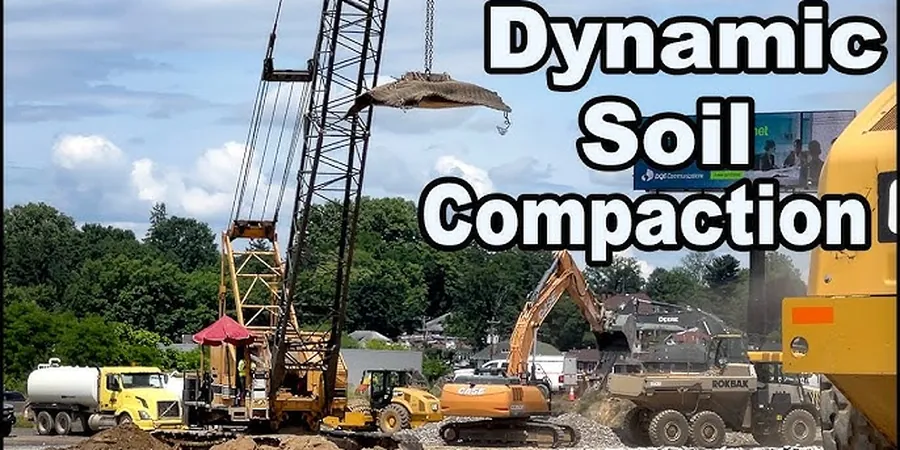
Dynamic compaction in Bunbury requires energy calibration to the coastal sand's collapse potential, verified by CPT and plate load testing.
Approach and scope
Site-specific factors
The drop tower used in Bunbury needs a stable base on the existing ground, often a crane-mounted or tripod-rig system that can handle repeated impacts without sinking into soft topsoil. On sites with shallow clay lenses, the first pass can cause pore pressure buildup, reducing energy transfer efficiency. We monitor crater depth and surface heave after each pass to adjust the pattern in real time. Over-compaction in silty zones can create a low-permeability crust that traps water below, so drainage provisions must be designed into the sequence.
Regulatory framework
AS 1726:2017 Geotechnical Site Investigations, AS 4678:2002 Earth Retaining Structures, AS/NZS 1170.0:2002 Structural Design Actions
Related technical services
Pre-treatment site assessment
CPT and MASW surveys to map soil layering and collapse potential, defining target depth and energy requirements for each drop point.
Drop pattern design and energy calibration
Calculation of grid spacing, drop height, and number of passes based on target density and available equipment, with real-time adjustment during execution.
Post-treatment verification
Plate load tests, CPT soundings, and settlement monitoring to confirm that modulus and bearing capacity meet design criteria.
This service complements our laboratory testing work for a complete project analysis.
Typical parameters
Top questions
How does dynamic compaction design differ for Bunbury's coastal sand compared to inland sites?
In Bunbury, the shallow groundwater table and presence of estuarine clay lenses require lower initial energy and more passes to avoid pore pressure buildup. The design must also account for seasonal water level variation of up to 1.5 m, which affects compaction efficiency in the upper 4 meters.
What is the typical improvement depth achievable with dynamic compaction in Bunbury?
For clean sand deposits, improvement depths of 6 to 10 m are common. In zones with interbedded clay layers, the depth reduces to 3 to 5 m. The collapse potential from CPT data directly guides the energy required per drop.
What is the cost range for dynamic compaction design services in Bunbury?
The cost for dynamic compaction design in Bunbury typically ranges between AU$1,870 and AU$7,110, depending on site area, number of test points, and verification testing required. This covers the pre-treatment investigation, pattern design, and post-treatment reporting.
Can dynamic compaction be used on sites with existing structures nearby in Bunbury?
Yes, but with careful vibration monitoring and reduced drop heights. We design a perimeter buffer zone and use smaller weights (10–15 t) near sensitive buildings. Vibration limits follow AS 2187.2 and are verified with seismographs during the first passes.