Bunbury’s growth as a regional hub has pushed development onto the soft alluvial flats around the Leschenault Estuary and the lower Collie River. Early port infrastructure was built on beach sands and Tamala limestone, but modern subdivisions and commercial precincts now sit on thick sequences of compressible silty clays and peats. A reliable deep soil mixing design is essential when you’re dealing with ground that can’t support conventional shallow footings. Before specifying the DSM mix, we always cross-check against a plate load test to calibrate the target modulus, and we review nearby borehole logs for organic content that affects binder reactivity. Getting the design wrong here means differential settlement within the first few years, so the upfront geotechnical work pays for itself fast.
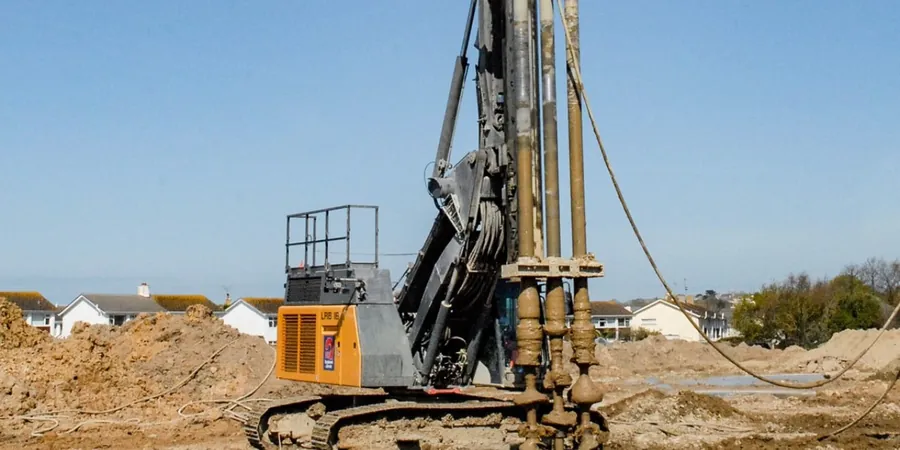
Deep soil mixing columns in Bunbury’s soft clays typically achieve 0.8–1.5 MPa unconfined strength with a 300 kg/m³ cement-slag binder.
Approach and scope
Site-specific factors
Bunbury sits on the Swan Coastal Plain, where Holocene alluvium reaches depths of 15 metres in places. The water table is high — within 2 metres of the surface near Koombana Drive. If a deep soil mixing design ignores the variability of organic content across the site, unreacted binder pockets can leave soft zones that settle unevenly. We’ve seen projects where mixing parameters from one side of a block didn’t transfer to the other because the clay fraction changed from 40% to 65%. That’s why we run a minimum of three trial columns per site and verify with full-length coring. To manage slope stability around excavations, we often integrate stabilisation of slopes with the DSM layout to avoid lateral squeeze during installation.
Regulatory framework
AS 1726 – Geotechnical site investigations, AS 4678 – Earth retaining structures, FHWA-HRT-17-080 – Deep mixing design manual, Eurocode 7 (EN 1997-1:2004) – Geotechnical design
Related technical services
DSM Mix Design & Trial Columns
Laboratory formulation of binder blends using site-specific soil samples, followed by field installation of trial columns. Includes coring, UCS testing, and permeability checks to validate design assumptions before full-scale production.
Structural DSM Layout & Verification
Design of column arrangement, overlap ratios, and load-transfer platforms. We produce settlement contour plots and factor-of-safety charts, then verify installed columns with real-time monitoring and post-construction coring.
Typical parameters
Top questions
How does deep soil mixing differ from jet grouting for Bunbury clays?
Deep soil mixing mechanically blends the binder with the in-situ soil using auger shafts, while jet grouting uses high-pressure fluid to erode and mix. For Bunbury's soft, homogeneous clays, DSM is generally more cost-effective and produces consistent column properties. Jet grouting is preferred for discrete inclusions or where groundwater flow is high. We select the method based on target strength, column geometry, and site access.
What is the typical cost range for a deep soil mixing design study in Bunbury?
A comprehensive design study, including lab mix design, trial columns, and verification testing, typically ranges between AU$2,900 and AU$9,980 depending on the number of trials and the depth of treatment. Production costs per cubic metre are quoted separately after design approval.
How long does a DSM design and verification programme take?
The laboratory phase takes 2–3 weeks for curing and UCS testing. Field trial columns and coring add another 1–2 weeks. Full design sign-off, including load-test correlation, is typically completed within 5–6 weeks from sample receipt. Faster programmes are possible for urgent projects with pre-qualified binder blends.